Hebrish now has its first two stable models: Jachnun v1.0 (19 October 2026) and Sabich v1.0 (20 October 2026). Both are fine-tunes of NVIDIA's Parakeet TDT 0.6B v2 that write the Hebrew words in English speech correctly, in one consistent romanized spelling. This post is the technical deep dive: what the two models are, the data they learned from, how they were trained and how they score. The full white paper is embedded at the end, to read or download.
If you're new here: Hebrish is my one-person, not-for-profit project for English-Hebrew dictation, and Voice typing that understands Hebrish is the non-technical introduction, with the apps.
Two models, one base
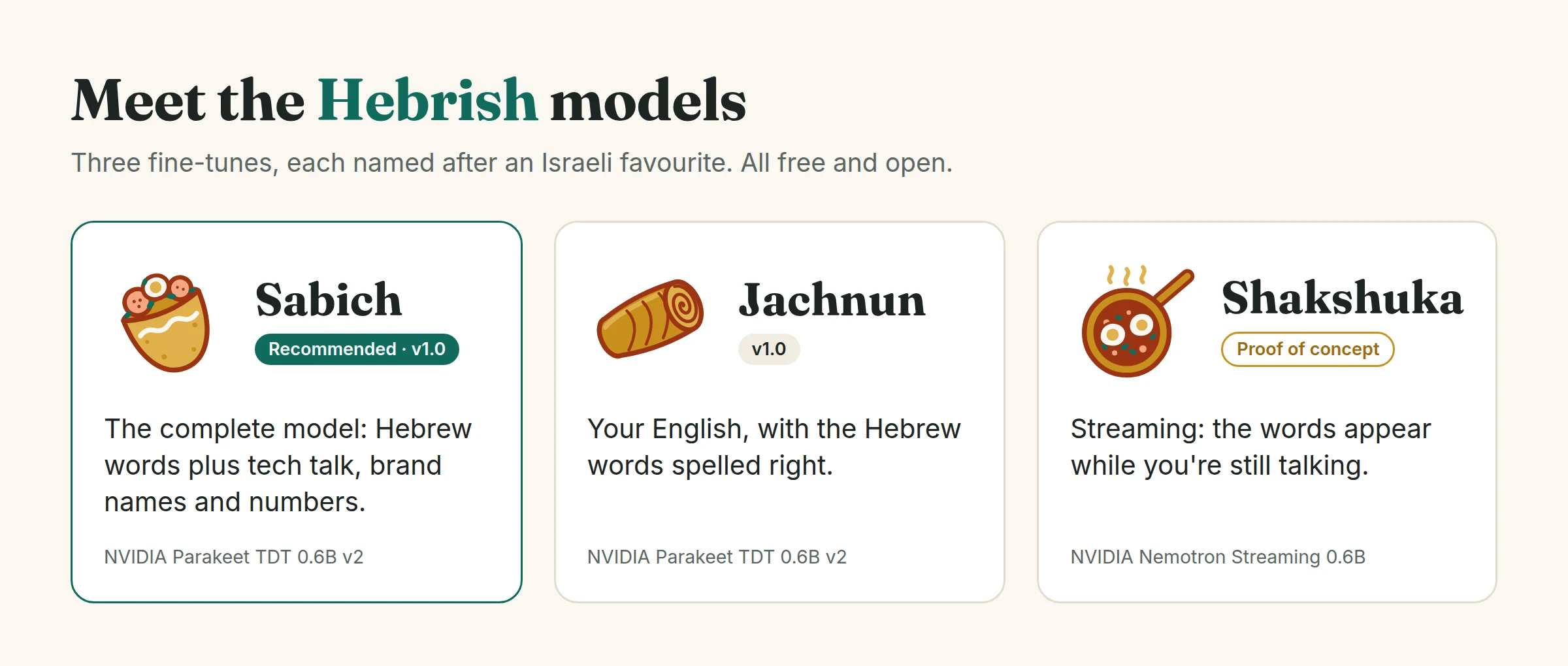
Jachnun v1.0 was the first stable release. It's trained on English sentences with Hebrew words in them, plus my own plain English and a little general English, so that it learns the Hebrew words without losing its English.
Sabich v1.0 is named after the pita with a bit of everything in it. It's trained on the same kind of code-switched recordings plus every other task I'd recorded: tech vocabulary, brand names, acronyms, numbers and currency, disfluencies and self-corrections. Because the extra recordings cost nothing on Hebrew words (see the results below), Sabich is now the model the apps recommend.
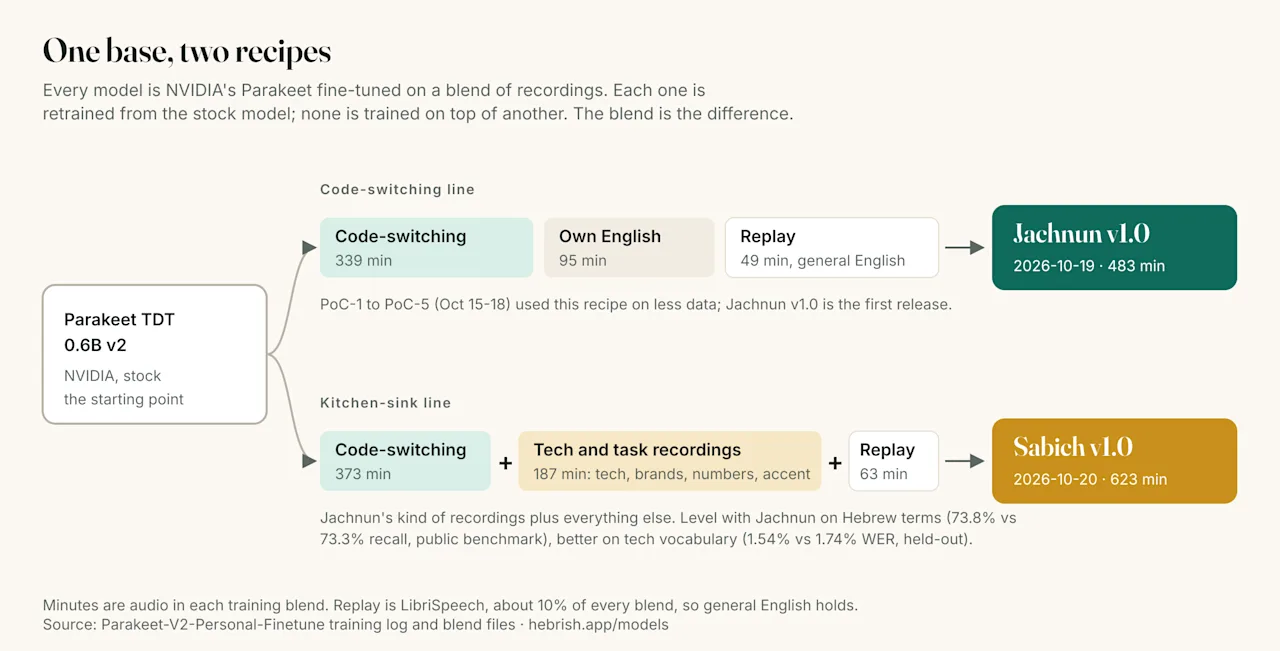
Neither is trained on top of the other. Each starts from the stock Parakeet model, and the only difference is the blend of recordings it learns from.
Parakeet TDT 0.6B v2 was the starting point because it's small enough (0.6 billion parameters) to run on a laptop CPU and on a phone, which is where dictation happens, and because in my own dictation it was more accurate for English than the newer, multilingual v3. Its tokenizer has no Hebrew characters, so Hebrew script was never an option. Romanization suits the use case anyway: the output is English text.
The data
Everything is trained on one dataset of read-aloud recordings: each clip is me reading a prompted sentence on my phone, as 16 kHz mono audio with a cased, punctuated transcript and the Hebrew terms it contains. Each Hebrew word has one canonical spelling, from a public spelling lexicon of over a thousand terms (makolet, Bituach Leumi, teudat zehut). The dataset page on hebrish.app has the details and the lexicon is browsable.
For Jachnun v1.0 the training blend was 483 minutes in all:
339.2 minutes of code-switched sentences (3,224 clips), across everyday life: government offices, food, places, religious life, banking, school and the army.
95.3 minutes of my own plain English, so the model learns that English in this voice should stay plain English.
48.5 minutes of LibriSpeech audiobook English (other speakers), as a general-English anchor.
About 30% of the blend is English on purpose. Fine-tuning only on new-domain speech is what makes a model forget what it knew ("catastrophic forgetting"), and mixing the original domain back in is the standard remedy.
Sabich's blend was larger: 373.1 minutes of code-switching, 187.4 minutes of tech and task recordings, and 62.5 minutes of LibriSpeech, 623 minutes in all.
The test set is designed so the results mean something. A list of Hebrew terms is held out: any sentence containing one goes to the test set, so those words never appear in training. The evaluation reports two numbers: how often the model writes a held-out word it was never taught (generalisation), and how often it writes test words that it did see in training (learning).
Training
Each release is a full fine-tune from stock Parakeet on every recording made so far, not a continuation of the previous model. Continuing on new data alone causes forgetting, and a run costs about US$0.80, so there's nothing to save by continuing.
Framework: NVIDIA NeMo 2.7.3, on a rented GPU through Modal.
Optimiser: AdamW, learning rate 3e-5, cosine schedule with 10% warmup.
Length: 20 epochs, batch size 16, bf16 mixed precision, seed 7.
Selection: the best epoch on a validation split that is part of training, never the test set. For Jachnun, epoch 18 (validation WER 5.0%); for Sabich, epoch 19.
Hardware and time: one NVIDIA L40S. Jachnun took 41.0 minutes, Sabich 52.1.
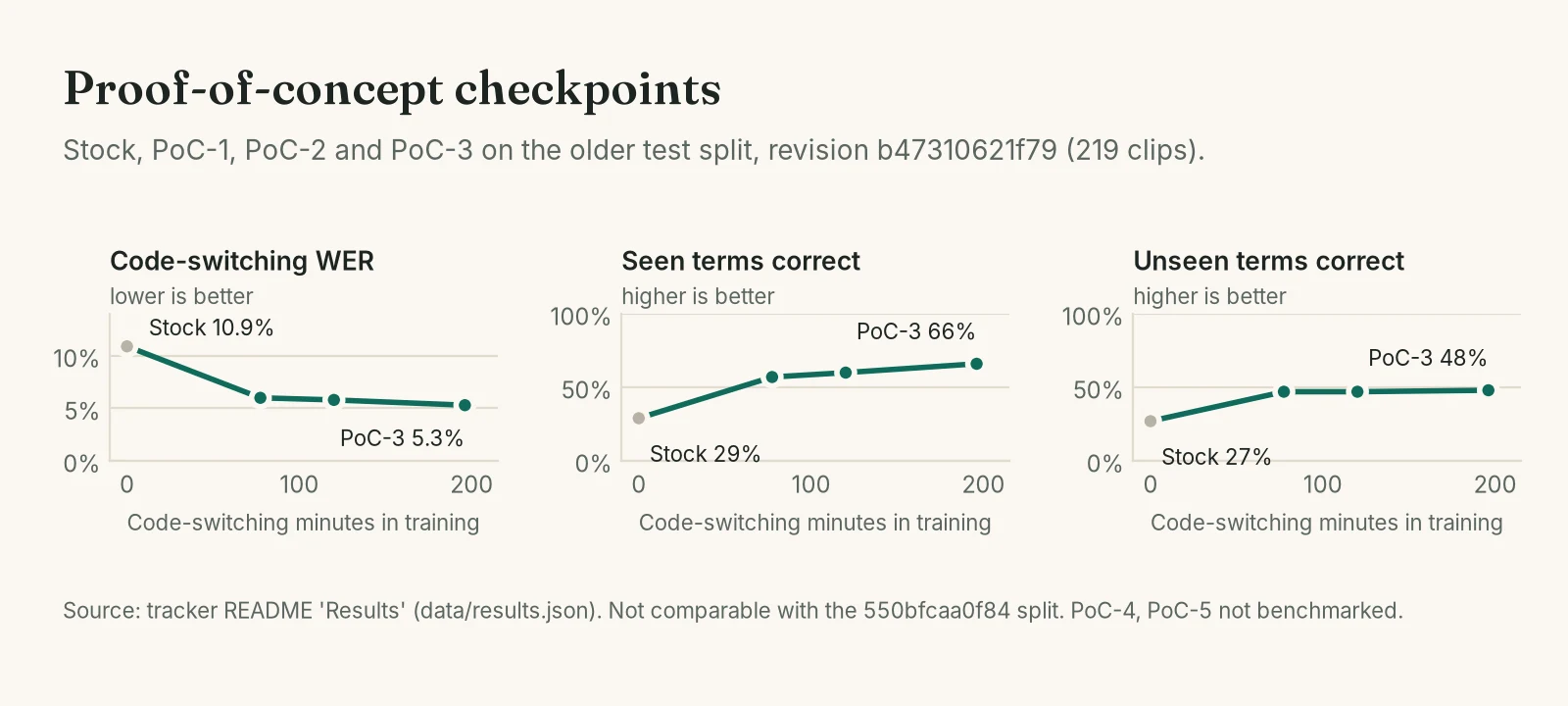
Before v1.0 there were five proof-of-concept checkpoints, PoC-1 to PoC-5 (published on Hugging Face at the time as v1 to v5), each trained the same way on more recordings, from 77 minutes of code-switched speech up to 294. Errors fell at every step that was benchmarked.
How Jachnun v1.0 scores
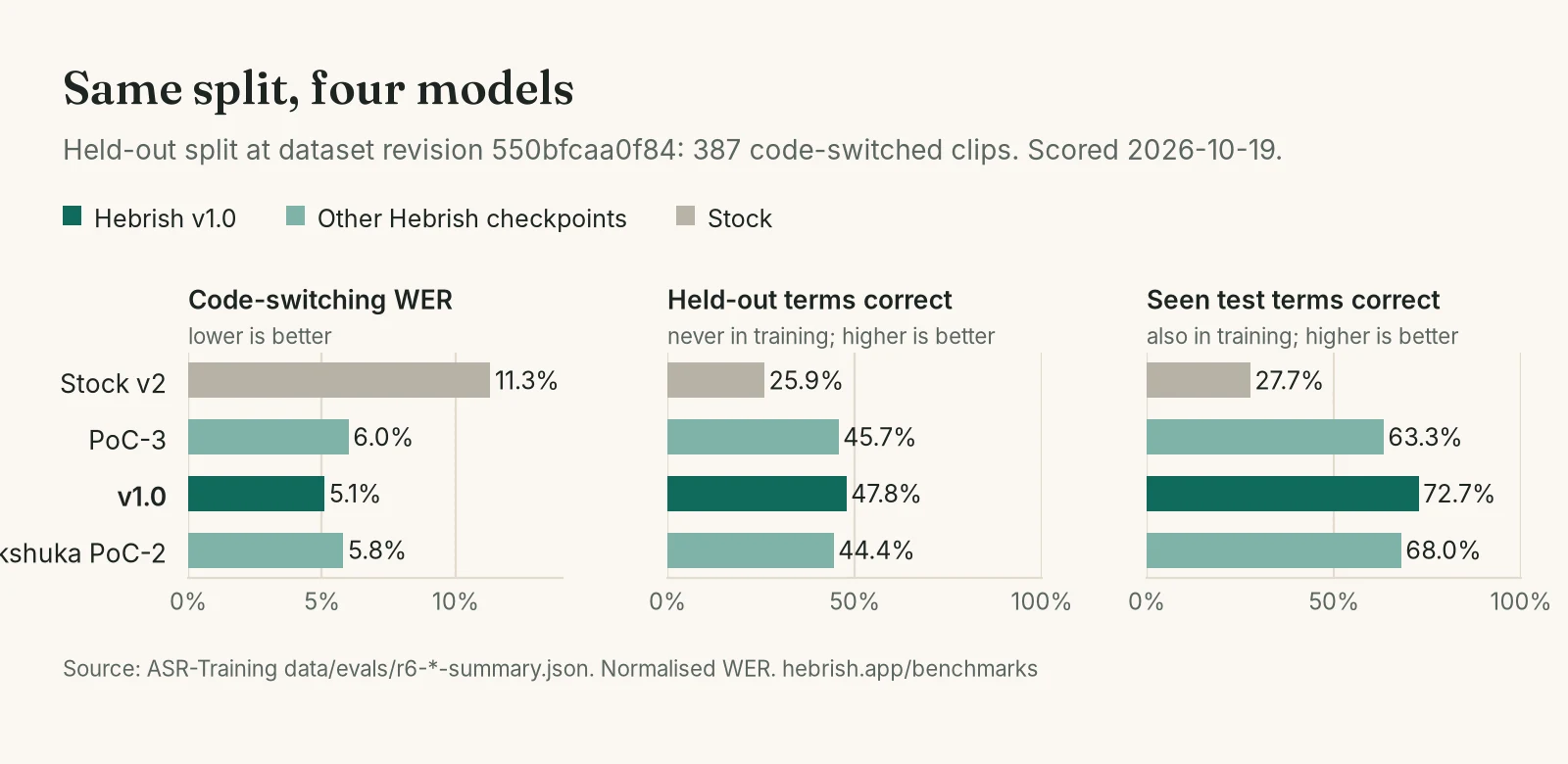
On the project's own held-out split (387 code-switched recordings that were never in training), Jachnun v1.0 cut the word error rate from 11.3% to 5.1%. Test words it had seen in training came out right 72.7% of the time, against 27.7% for stock Parakeet. Held-out words, never in training, went from 25.9% to 47.8%: it has learned how Hebrew sounds map onto English spelling, not just a word list.
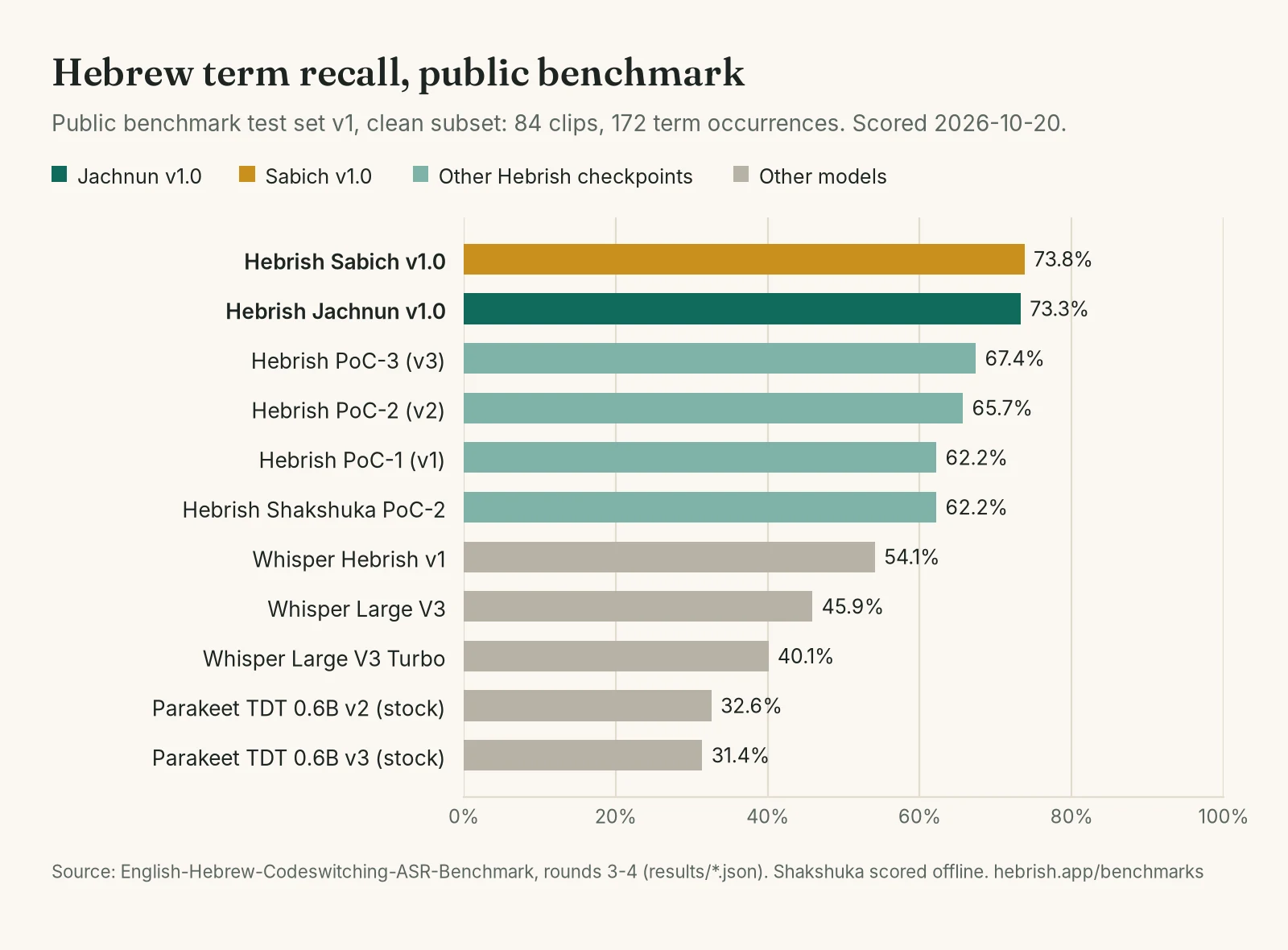
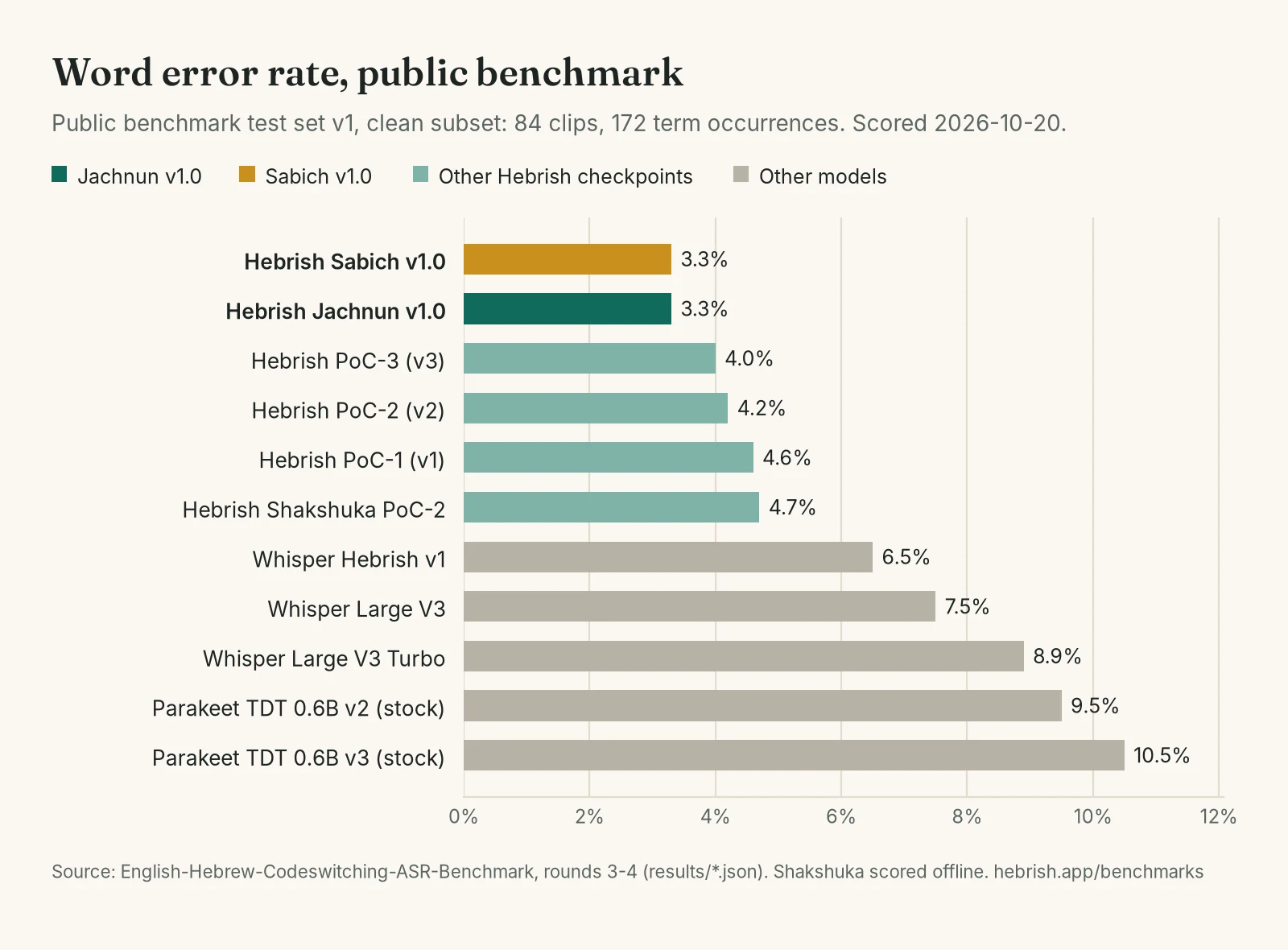
On the public English-Hebrew benchmark (84 phone recordings of sentences in no published training set, 172 Hebrew word occurrences), Jachnun v1.0 writes 73.3% of the Hebrew words correctly and 70.1% of the ones absent from training, against 45.9% for OpenAI's Whisper Large V3 and 32.6% for stock Parakeet. Its word error rate there is 3.3%, against 9.5% for stock Parakeet.
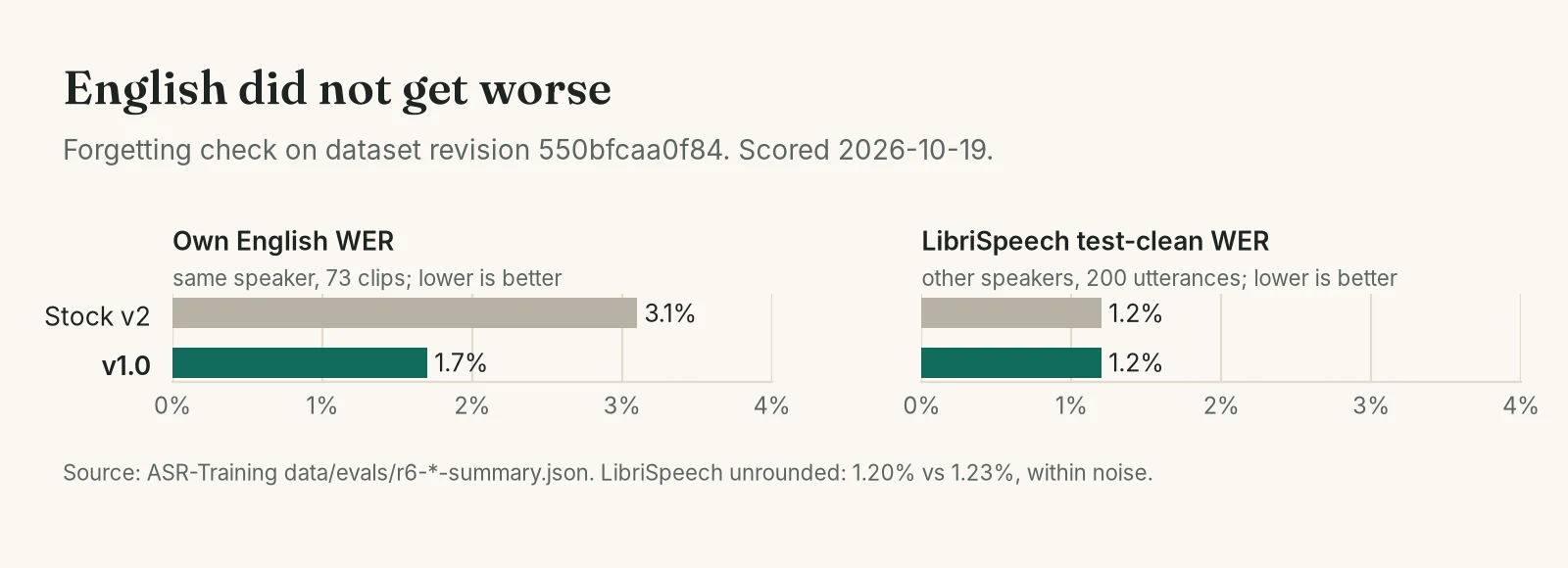
And English didn't get worse: my own plain English went from 3.1% errors to 1.7%, and on LibriSpeech (other people's English) it scored 1.20% against stock's 1.23%, a difference within noise, which is the point.
How Sabich v1.0 compares
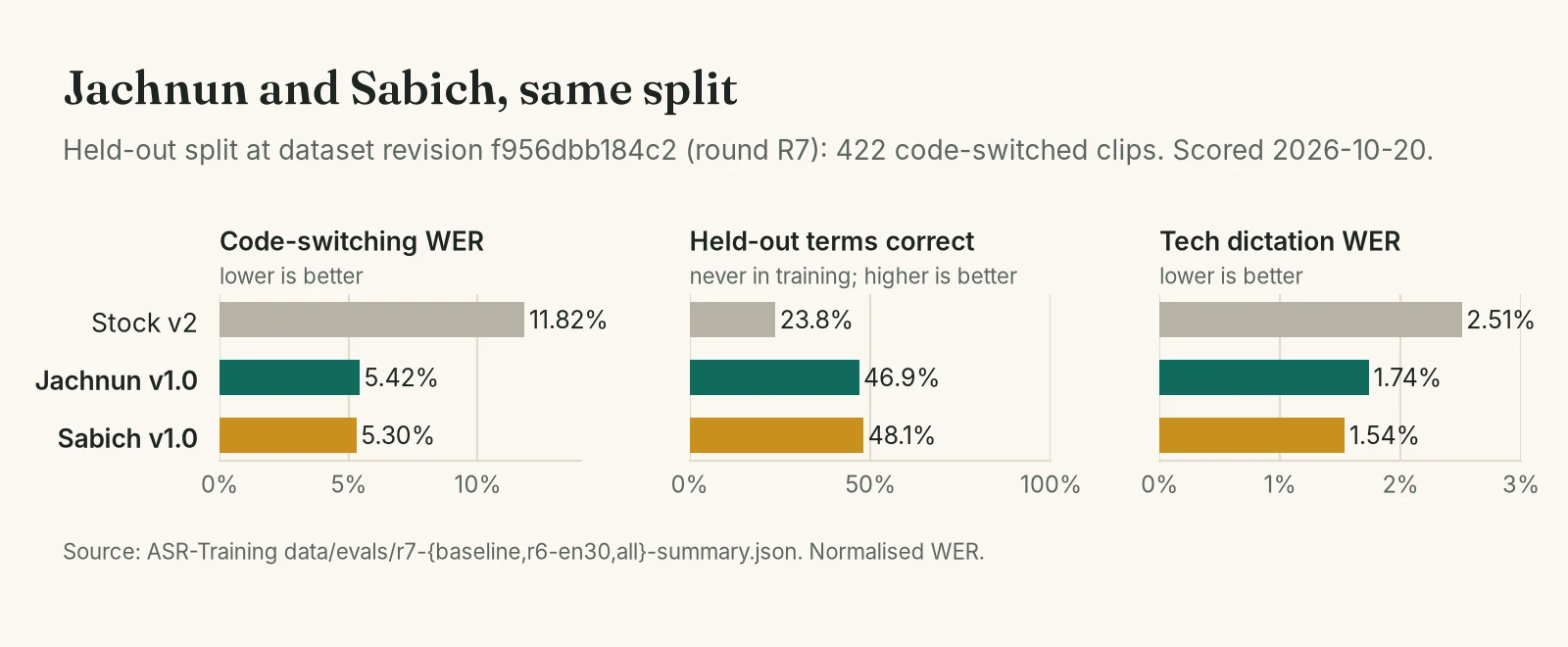
Sabich was scored against Jachnun and stock Parakeet on a newer, larger round of the held-out split (422 code-switched recordings). Adding all the extra task recordings didn't cost any code-switching accuracy: 5.30% word error rate against Jachnun's 5.42%, and 48.1% of held-out words right against 46.9%. On tech dictation it gained modestly: 1.54% word error rate, against 1.74% for Jachnun and 2.51% for stock.
On the public benchmark the two are level: 73.8% of Hebrew words for Sabich against 73.3% for Jachnun, which is one word out of 172. One honest footnote: on LibriSpeech, Sabich scored 1.30% against stock's 1.23%, a strict miss of the project's forgetting check by about three words in 200 clips, which I've accepted as noise.
That's why Sabich is now the apps' recommended pick. But the gaps are small and come from one round of tests on one voice, so if one isn't giving you good results, try the other: both are in the Hebrish apps, next to stock Parakeet, and switching takes a tap.
Formats
Jachnun v1.0 is published in the formats on-device tools use, and each export was checked against the full-precision model before release:
sherpa-onnx int8, which the Hebrish apps for Android, Linux and Windows run.
ONNX (fp32 and int8), for onnx-asr, Voxtype and the in-browser demo on hebrish.app.
GGUF (F16, Q8_0, Q4_K_M), for transcribe.cpp, Handy and Offline Voice Input.
MLX, for Apple silicon Macs (run it in fp32).
Sabich v1.0 has the sherpa-onnx, ONNX, GGUF and MLX builds too. Every format, with its download and citation details, is on hebrish.app/models.
In passing: Shakshuka
The same recordings and recipe were also used to fine-tune NVIDIA's Nemotron streaming model, which can show text while you're still speaking. That line is called Shakshuka, and it's still a proof of concept: Shakshuka PoC-2 writes 62.2% of the Hebrew words correctly on the public benchmark, behind Jachnun, and it was scored offline, so its streaming accuracy hasn't been measured yet. The first retrain will be Shakshuka v1.0. More on hebrish.app.
Limitations
One speaker. Every recording, training and test, is my voice: Irish-born, English-speaking, living in Jerusalem, mostly on one phone. The results rank models on this speaker. More voices are the project's main need.
Read speech. Prompted sentences read aloud are cleaner than spontaneous dictation.
Small test sets. On 172 word occurrences, a difference of two or three points is within noise.
One spelling per word. The canonical spelling is a convention: tsaharon for tzaharon isn't wrong in an absolute sense.
The white paper
The full technical write-up is the Hebrish model release 1 white paper: Jachnun v1.0 and Sabich v1.0 together, with the dataset splits, training settings, every result table, the exports, cost and limitations, and a section on Shakshuka as work in progress. It's embedded here to read or download, and the original is on hebrish.app.
There's a Hebrew edition too, with the same content and numbers (also on hebrish.app):
What's next
The limit on Hebrish isn't computing power; a training run and a benchmark round together cost about US$1.30. It's recordings. Retrains of Jachnun will be v1.1, v1.2 and so on, and the apps pick them up as updates. If you speak English with Hebrew words in it and would record some sentences, get in touch; if a word keeps coming out wrong, suggest it.
