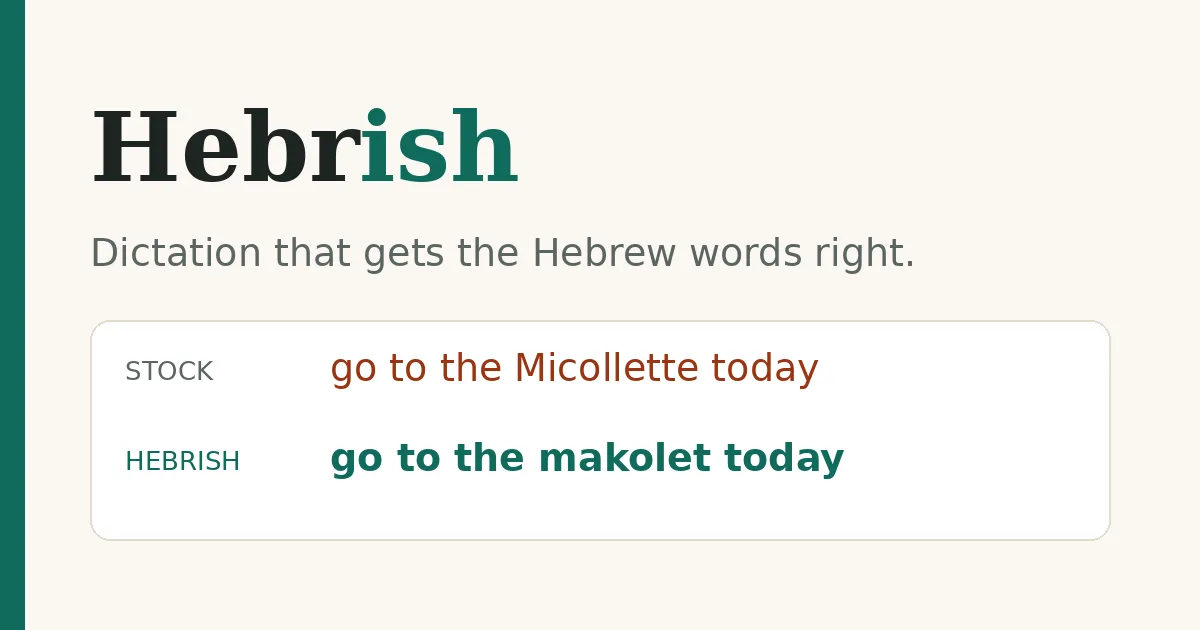
Over the past few weeks I've published quite a few speech recognition models that do one thing: get the Hebrew words right when English speakers in Israel dictate. They were scattered across my Hugging Face account, a few GitHub repositories and a handful of posts on this blog. They now have one home, and a name: Hebrish, at hebrish.app.
Hebrish is a one-person, not-for-profit project. Its mission, in one line:
Improving ASR accuracy for code-switched English-Hebrew for English-speaking immigrants in Israel and users throughout the Jewish world.
ASR is automatic speech recognition: the part of dictation that turns your voice into text. The problem is simple to describe. You pay the arnona, renew your teudat zehut, pop out to the makolet, and the speech recognition hears those words and writes whatever English words sound closest. Every dictated message then needs fixing by hand. (The longer story, with real examples, is in Voice typing that understands Hebrish.)
What's on hebrish.app
The site gathers everything I've published for that purpose in one place:
The apps. Free dictation apps for Android, Ubuntu and Windows that run the models on your own device. Nothing you say is uploaded. Download.
The models. Every fine-tune, with its formats, versions, results and citation details. All models.
The data. The read-aloud recordings the models are trained on, and a spelling lexicon of over a thousand Hebrew terms. Dataset, lexicon.
The results. A public English-Hebrew benchmark and every evaluation, with how each was measured. Benchmarks.
A demo that runs the model in your browser. Try it.
The models
The model lines are named after Israeli foods.
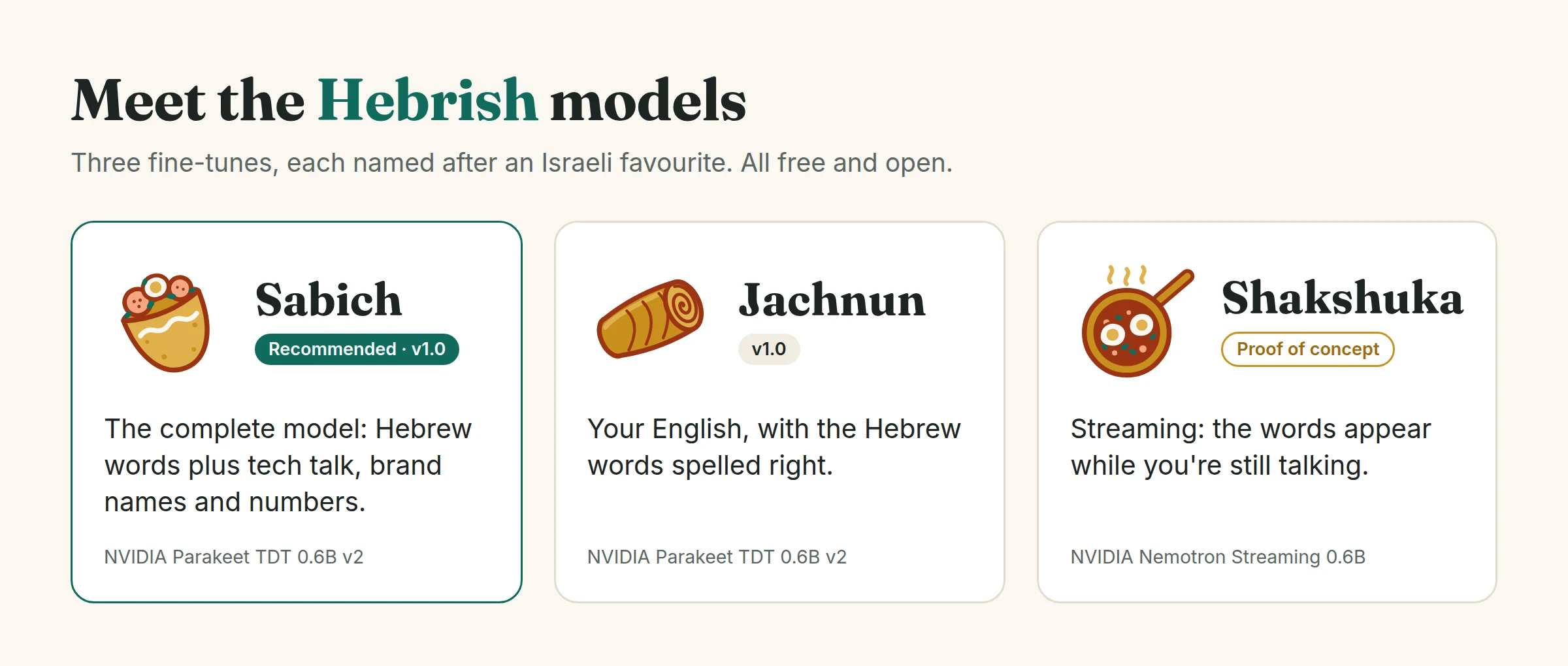
Sabich: the pita with a bit of everything, and what the apps recommend. A fine-tune of NVIDIA's Parakeet TDT 0.6B v2 on English with Hebrew words in it, plus tech vocabulary, brand names and numbers. The current release is Sabich v1.0. Sabich.
Jachnun: the same base, trained on the Hebrish recordings alone: your English, with the Hebrew words spelled right. The current release is Jachnun v1.0, and it's the other choice in the apps. Jachnun.
Shakshuka: the streaming line, on NVIDIA's Nemotron streaming model, so text can appear while you speak. Still a proof of concept. Shakshuka.
Whisper Hebrish and Whisper Hebrish Small ACFT: fine-tunes of OpenAI's Whisper, where the project started in November 2025. The small one runs in FUTO Keyboard on Android. Whisper models.
The Hebrew-Latin Token Classifier: a small model that finds romanized Hebrew words inside English text, so text-to-speech can pronounce them properly. Token classifier.
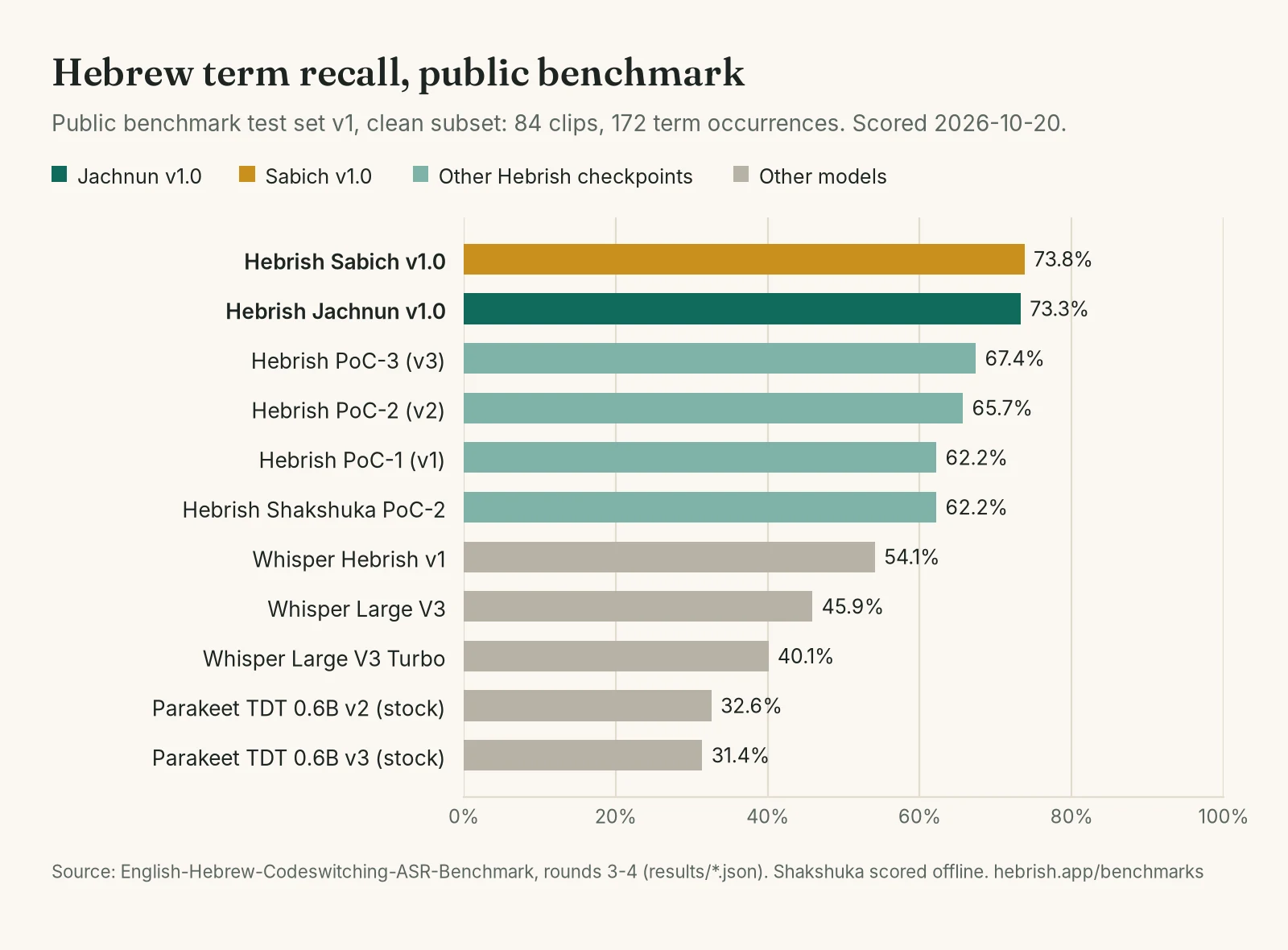
On the public benchmark, Jachnun v1.0 and Sabich v1.0 get about 73% of the Hebrew words right, against 46% for OpenAI's Whisper Large V3 and 33% for the standard Parakeet. How the two were trained and tested is in Jachnun and Sabich, in depth, with the white paper.
How it works as a project
Free. The apps cost nothing, have no accounts and no ads. The models are free for personal, research, education and non-profit use; commercial use, such as telephony, needs a licence. Terms.
Open. The app source is on GitHub, the models and data on Hugging Face, and the results can be checked.
Small. The models are trained on recordings of one speaker, me, so far. Each training run costs under a dollar of GPU time. The limit is how many sentences I can read aloud, not computing power.
How you can help
The most useful thing is more voices. If you speak English with Hebrew words in it and would record some sentences, get in touch. If speech-to-text keeps getting a word wrong for you, suggest the word and it goes into the next training round. And if you try the apps, tell me how they do with your voice.
Everything new is on the changelog, and there's a newsletter at the bottom of every page on hebrish.app.
