
With the Iran-Israel conflict dominating headlines and considerable speculation about whether the current military pressure could topple the regime, I decided to run the Geopol Forecaster pipeline on a deliberately ambitious question: what is the probability of forced regime change in Iran — not just the IRGC losing power, but replacement by a non-autocratic government that formally recognises Israel and renounces intention to eliminate it?
I set a high definitional bar deliberately. A military coup that installs a different set of IRGC generals doesn’t count. A cosmetic reform that leaves the theocratic structure intact doesn’t count. The question asks for genuine regime transformation — the kind of outcome that would represent a fundamental shift in the Middle Eastern security landscape.
(For background on how the pipeline works, see my earlier post: Geopol Forecaster: An Open-Source AI Geopolitical Prediction Pipeline.)
The headline numbers
The chairman’s synthesis: less than 1% probability at one week. 1-3% at one month. 4-9% at one year. Confidence was rated high for the near-term horizons and moderate for the one-year window.
These numbers are notably conservative given the military context. At the time of the forecast (April 10th, 2026), 85% of Iran’s defence industrial base had been destroyed, public dissatisfaction sat at 92%, and active diplomatic and covert pressure campaigns were underway. The fact that the pipeline still produced single-digit probabilities tells you something about how the analytical lenses weighted institutional resilience against external pressure.
Why military degradation hasn’t translated to regime cracking
The most important finding — and the one most relevant to the policy discourse — is that IRGC institutional resilience exceeds external military degradation by a wide margin. Despite catastrophic losses to the defence industrial base, the IRGC maintains control through mechanisms that aren’t vulnerable to airstrikes: economic entrenchment (they control an estimated 40% or more of the Iranian economy), ideological selection of officers, and a multi-layered internal security apparatus (Basij, IRGC Intelligence, and overlapping parallel structures specifically designed to prevent coups).
The Historical lens was particularly sharp on this point. The IRGC survived the Iran-Iraq War (over 500,000 casualties), the 2009 Green Movement, and the 2019 and 2022 protest waves. Each time, the regime’s internal security mechanisms held. The Probabilistic lens added a base rate: authoritarian regimes with intact security services collapse under external pressure at roughly 4-8% per year (1945-2020 dataset). Iran’s IRGC was specifically designed, after 1979, to prevent exactly the kind of military-to-civilian transition the forecast question asks about.
The binding constraint: opposition fragmentation
The second key finding is that 92% public dissatisfaction does not equal organised capacity for regime-threatening action. The council identified opposition fragmentation as the binding constraint — the factor that, more than any other, keeps the probability in single digits. There are no visible parallel governance structures, no unified leadership, no military coordination between opposition factions. Reza Pahlavi has been attempting to rally a unified opposition but without success.
The Historical lens drew a comparison to Poland’s Solidarity movement, which took from 1980 to 1989 to build the institutional capacity for regime transition — and that was with a far more permissive internal security environment than Iran’s. Expert consensus in the fresh data bundle was blunt: “external pressure alone rarely leads to regime change.”
Where the simulation overestimated
The actor simulation produced a one-year estimate of 12% — notably higher than the council’s 4-9% chairman synthesis. The divergence analysis revealed why: the simulation excels at modelling military and operational mechanics but overestimates regime fragility in the absence of internal IRGC fracture. The simulation modelled CIA covert funding strengthening opposition networks and 92% dissatisfaction rapidly activating into organised resistance. The fresh data contradicted this: experts consistently emphasised the organisational deficit, and no reporting supported the simulation’s assumption that external support could rapidly convert dissatisfaction into regime-threatening capacity.
Similarly, the simulation predicted deep Russian military integration with the IRGC (68% probability of direct involvement, joint air defence). The fresh data showed the opposite: Russia had evacuated 198 staff from Bushehr, signalling risk aversion rather than deepening commitment. The council revised this estimate significantly downward to 30-45% over one year.
Three pathways to regime change (and why they’re all unlikely)
The council identified three distinct pathways. The first (2-3% probability): a nuclear crisis leads to military humiliation which triggers an internal IRGC coup. The problem is that the most likely coup outcome would be more autocratic, not less — and certainly wouldn’t recognise Israel. The second (3-5%): economic collapse triggers mass uprising and a transitional government. This requires the IRGC to fragment, with junior officers or conventional military defecting — something that hasn’t happened despite enormous pressure. The third (1-2%): cascading simultaneous failures force a negotiated transition. This is the least probable because it requires the IRGC to accept existential threat to their economic empire, which controls nearly half the Iranian economy.
The bottom line for policy thinking
The council’s most pointed conclusion was directed at policy-makers: “Decision-makers should not plan on regime change as a probable outcome. Any strategy assuming regime change should have robust contingency for regime survival.” The most likely outcome (70% probability) is that the regime survives but weakened — the nuclear programme advances but doesn’t achieve weaponisation, economic pressure continues but doesn’t trigger mass uprising, the IRGC maintains control through repression and co-optation, and the regional proxy network degrades but isn’t eliminated.
That’s not the analysis most people want to hear right now. But the whole point of building a structured forecasting pipeline — rather than asking a model to tell you what you want to hear — is that the structure forces uncomfortable conclusions when the evidence points that way.
The full forecast data is published at github.com/danielrosehill/Iran-Regime-Change-Forecast-1004.
GitHub Repository danielrosehill/Iran-Regime-Change-Forecast-1004 Geopol Forecaster run: probability of forced regime change in Iran (+1 week / +1 month / +1 year). 10-actor simulation + 6-lens council. Headline: <1% / 1-3% / 4-9%. ★ 1PythonUpdated Apr 2026 View on GitHubForecast visualisations
The following charts were generated as part of the forecast run.
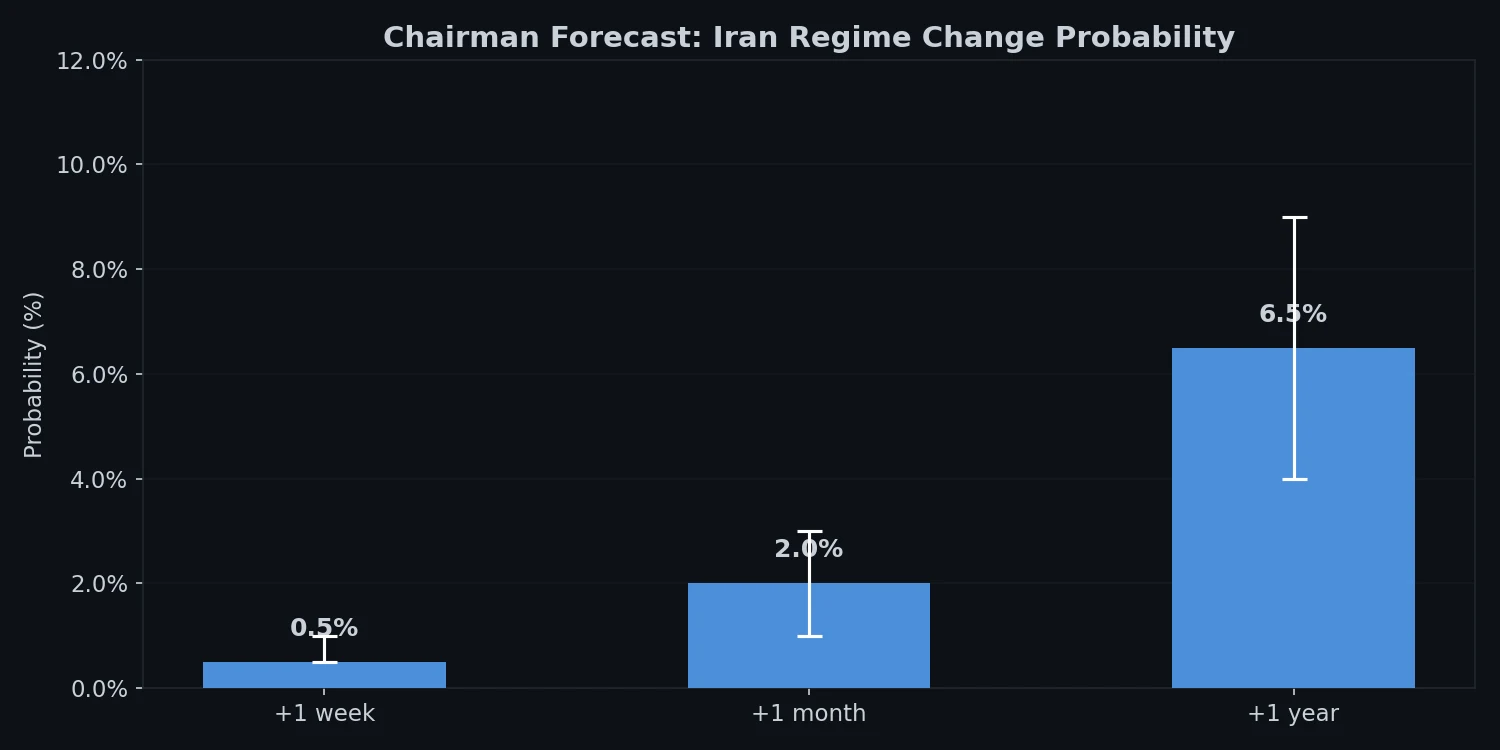
Chairman’s headline forecast across all time horizons.
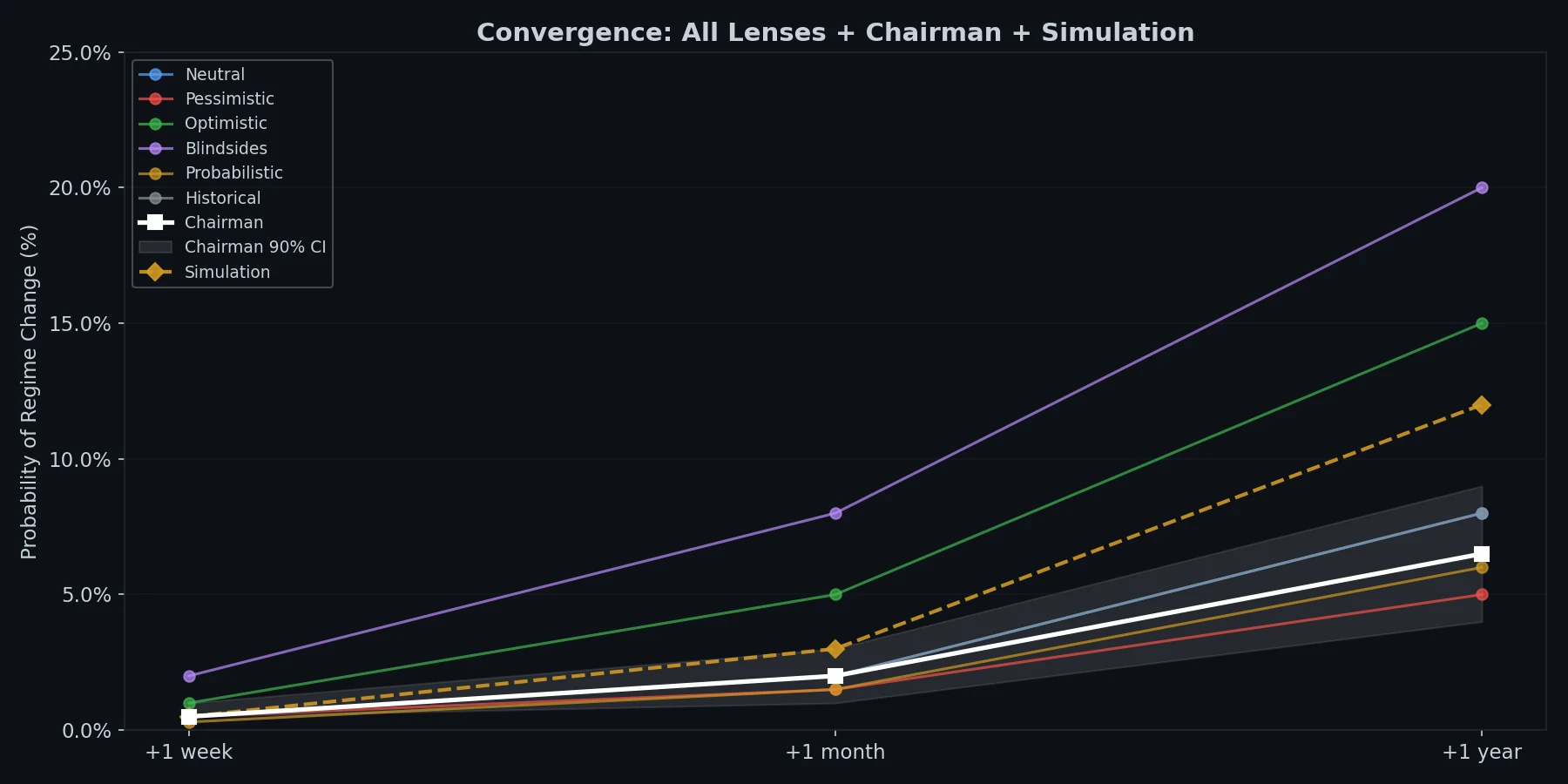
Probability estimates across all six analytical lenses.
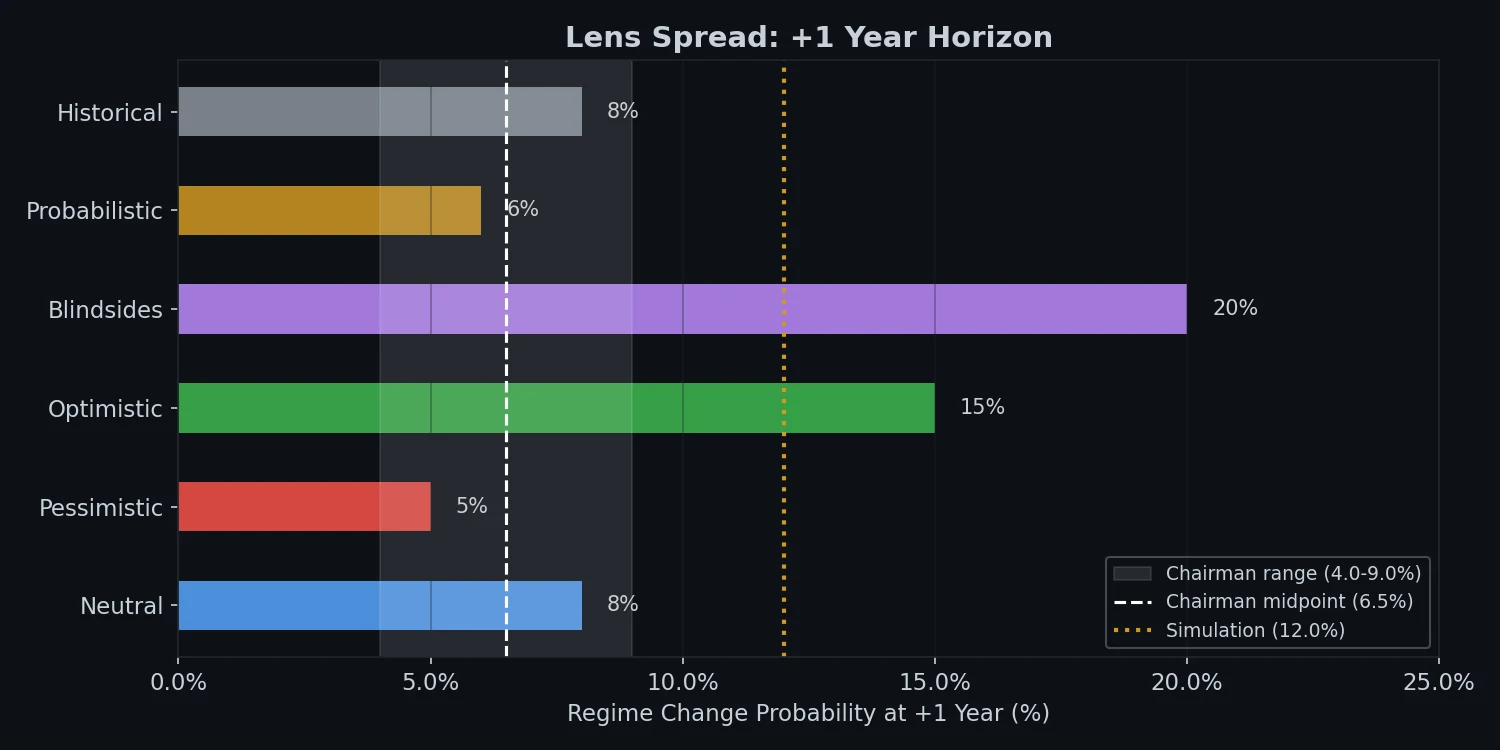
One-year lens spread showing divergence between analytical perspectives.
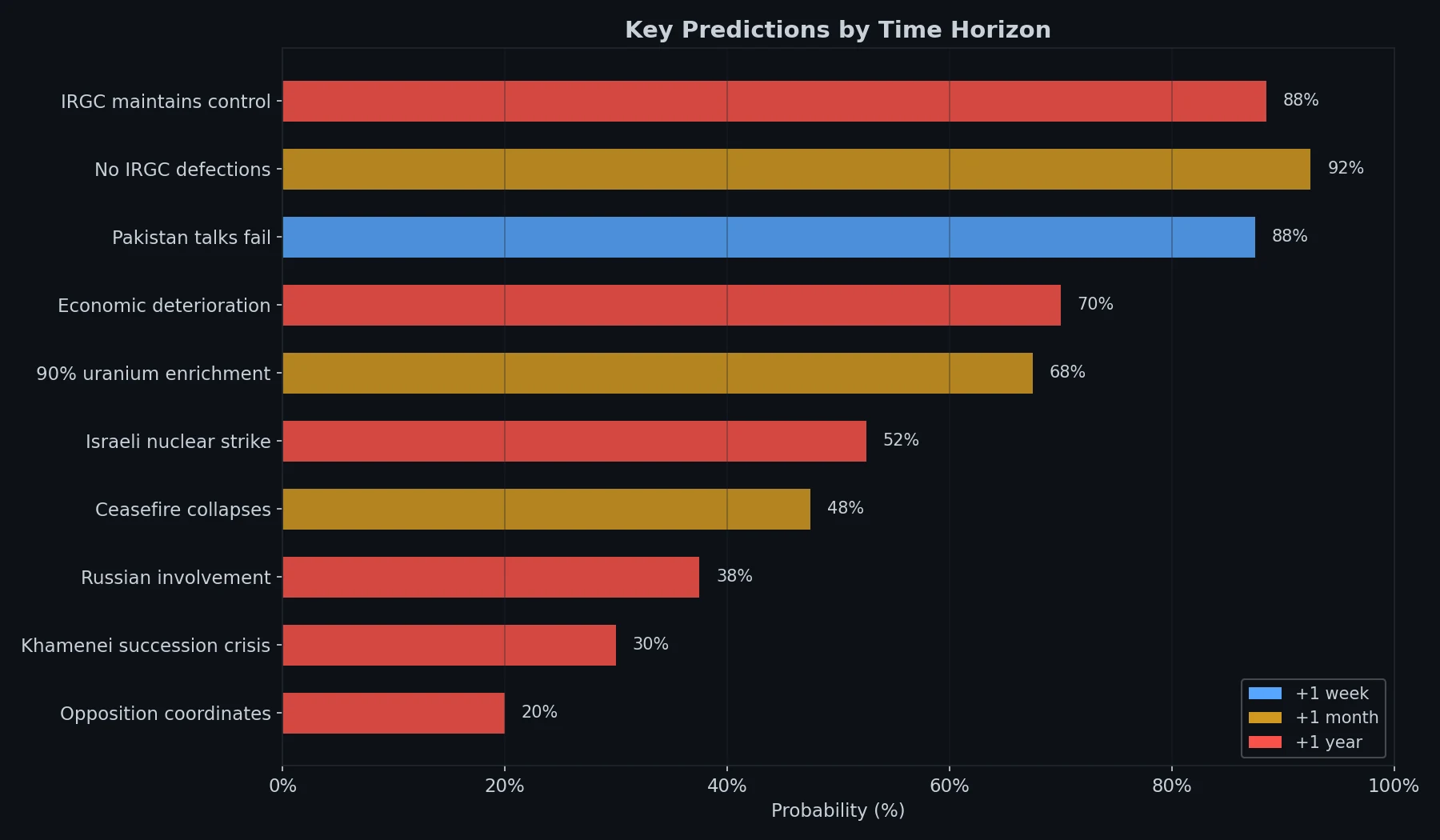
Key predictions with probability and confidence ratings.
Download the full report
The chairman’s full report is available as a PDF: Download Chairman’s Report (PDF). This includes the full probability analysis across all six lenses, simulation divergence findings, pathway assessments, and the council’s key indicators to monitor.
The stack
Geopol Forecaster is built on two key open-source projects and a handful of supporting tools:
Stage A (Actor Simulation): IQTLabs/snowglobe — an open-ended wargaming engine from In-Q-Tel’s research lab, featuring persona-driven actors and referee adjudication. Published alongside a peer-reviewed paper and featured in a CIA Center for the Study of Intelligence publication (December 2025).
GitHub Repository IQTLabs/snowglobe Open-ended wargames with large language models ★ 61PythonApache-2.0Updated Feb 2026 human-ai-teaminglarge-language-modelsmulti-agent-systemstabletop-exerciseswargames View on GitHubStage B (Analytical Council): karpathy/llm-council — Andrej Karpathy’s 3-stage deliberation protocol with parallel query, blind peer review, and chairman synthesis.
GitHub Repository karpathy/llm-council LLM Council works together to answer your hardest questions ★ 25.7kPythonUpdated Nov 2025 View on GitHubLLM: Claude Sonnet 4.5 via OpenRouter (single model, single router — diversity comes from prompt engineering, not model switching)
Orchestration: LangGraph with SQLite checkpointing
GitHub Repository langchain-ai/langgraph Build resilient agents. ★ 43.6kPythonMITUpdated Oct 2026 agentsaiai-agentschatgptdeepagents View on GitHubNews: Tavily search + RSS/ISW feeds, frozen into a single shared bundle
Memory: Pinecone vector archive for cross-run semantic retrieval
The full pipeline code is open source: github.com/danielrosehill/Geopol-Forecaster.
GitHub Repository danielrosehill/Geopol-Forecaster Experimentary prediction analysis for real world events (Iran Israel) ★ 6PythonUpdated Apr 2026 ai-agentsgeopoliticsiran-israel View on GitHub