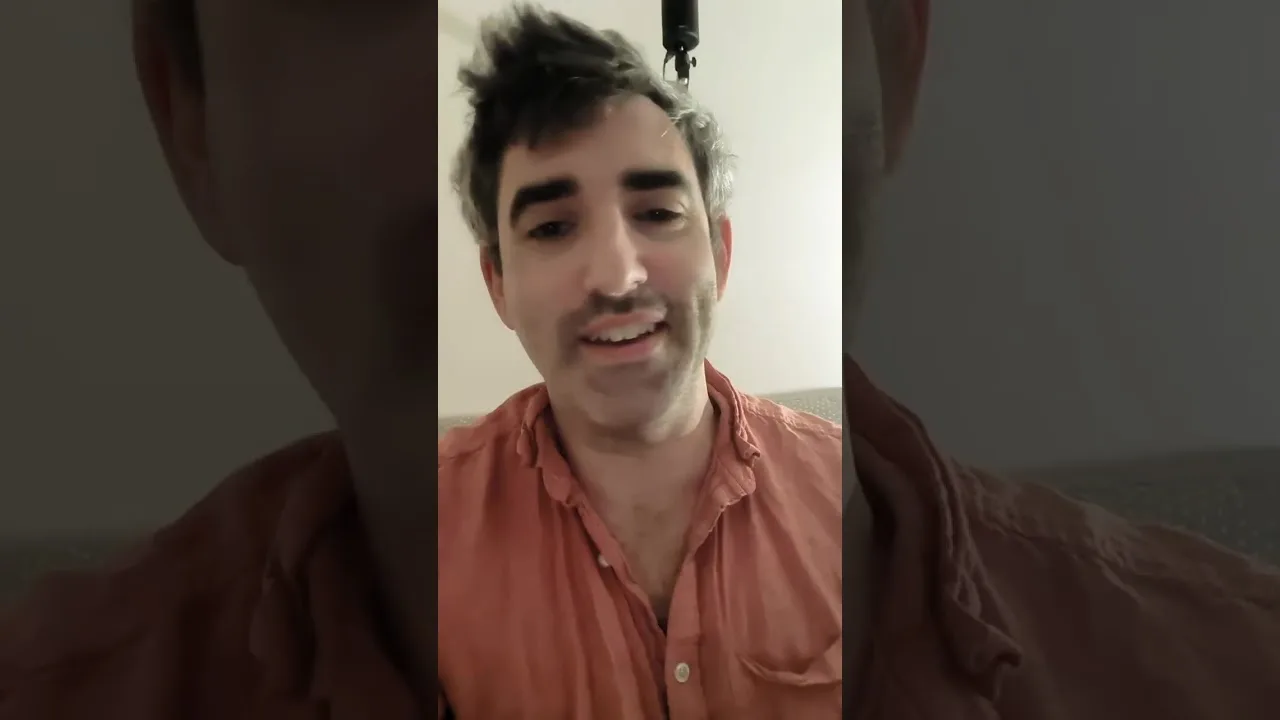
I recorded a short video on Friday, just before Shabbat here in Jerusalem, as a weekend update on where Hebrish stands. It runs about twelve and a half minutes (filmed on my phone, so it's portrait), and this is the written version for anyone who would rather read.
Why I train the models
About two years ago I started dictating all the time. Voice is now my keyboard, and it makes working with AI agents much easier, because you can give them far more context by talking than you ever would by typing. I spend hours a day dictating into Claude Code, ChatGPT and WhatsApp, so the first reason for all of this is simply my own accuracy.
The problem is Hebrew. Stock speech models guess English words for Hebrew ones. The common words (Shabbat, bar mitzvah) are covered, but the long tail isn't: the hundreds or thousands of street names, bus stops and supermarkets that make up daily life here. A personal dictionary helps a little, but it's hard to keep in sync across devices, so I fine-tune the model itself.
How the training data is made
There are two routes. In the first, I ask Claude for sentences around a word or a set of words (the most common street names in Jerusalem, say) and steer them towards realistic contexts. Sometimes I just write the sentences by hand. In the second, I build from appropriately licensed sources, such as place-name datasets, to reach the second and third tier of names that stock models miss.
I also train a few formatting habits into the model itself rather than fixing them afterwards, like writing 50 shekels as "50 NIS".
So far that adds up to about 56 to 60 hours of recordings. I'd like to pass 100, because those hours are what teach a model the sound of code-switched words.
The models
Sabich is the main model: everything, the full mix, trained as a rolling checkpoint with each update continuing from the last.
Jachnun is code-switching only. It's updated less often, because every fine-tune costs time and money.
Falafel is for voice commands, like telling a desktop assistant to put something on the right-hand screen.
Shakshuka is the streaming model, for live dictation.
Meorav is the text-to-speech line, and very much a work in progress. What transfers so far is mainly my own accent, and it needs more speakers.
Fritter, my English model for technical dictation (Docker, DevOps, host names), comes from the same recording sessions but isn't a Hebrish model: it has no code-switching. It got its own home this week.
The Hebrish apps run on Ubuntu, Windows and Android, with iOS on the way. The models are non-commercial because the project has real costs, but anyone who needs them (an English-speaking immigrant to Israel, for instance) can use them.
What it needs now
One speaker isn't enough. A robust model needs different accents, genders and communities: a South African woman who has lived here for five years, an American yeshiva student with an Ashkenazi pronunciation, Arab Israelis, and code-switching with Arabic and Yiddish as well as English.
So if you can, try the apps and tell me what works and which words still fail (with your accent, if you're happy to share it). If you'd like to record, that's the most valuable thing of all. And if you have GPU time to offer for training, that would be very welcome too.
The goal is a dictation tool that works for English speakers in Israel and across the wider Jewish world, Talmudic and biblical vocabulary included. The Hebrish site has its own write-up of the update, and the rest of the videos are on the Hebrish YouTube channel.
