I voice-type, using a speech recognition model I train myself. That sentence sounds tidier than the reality, which is that a model like that needs a great deal of me talking into a phone, and the recordings have a way of spreading. They've now spread across 39 datasets on Hugging Face, split between my personal account and Hebrish (the organisation for my English-Hebrew code-switching work).
So I've done some housekeeping. There's now a single Hugging Face collection, Audio Datasets - Mine, and a matching audio datasets index on my AI site, which lists everything in one place regardless of the account it sits on. (A sister collection holds the sentence datasets: the text-only lists I read from. This post is about the audio.)
How much audio is there?
About 44 hours, as of 7 November 2026.
Nearly all of that, 40.3 hours across 26,390 takes, sits in one master dataset: Read-Aloud Voice Sentences. The average take runs to five and a half seconds, which tells you what recording these is like: one sentence, then another, then another.
Hugging Face Dataset danielrosehill/Read-Aloud-Voice-Sentences ↓ 11.7kAutomatic speech recognitionCC-BY-4.0Updated Nov 2026 View dataset on Hugging FaceA warning before the numbers, though. Add up the hours listed against each dataset and you get almost 108, and that figure is fiction.
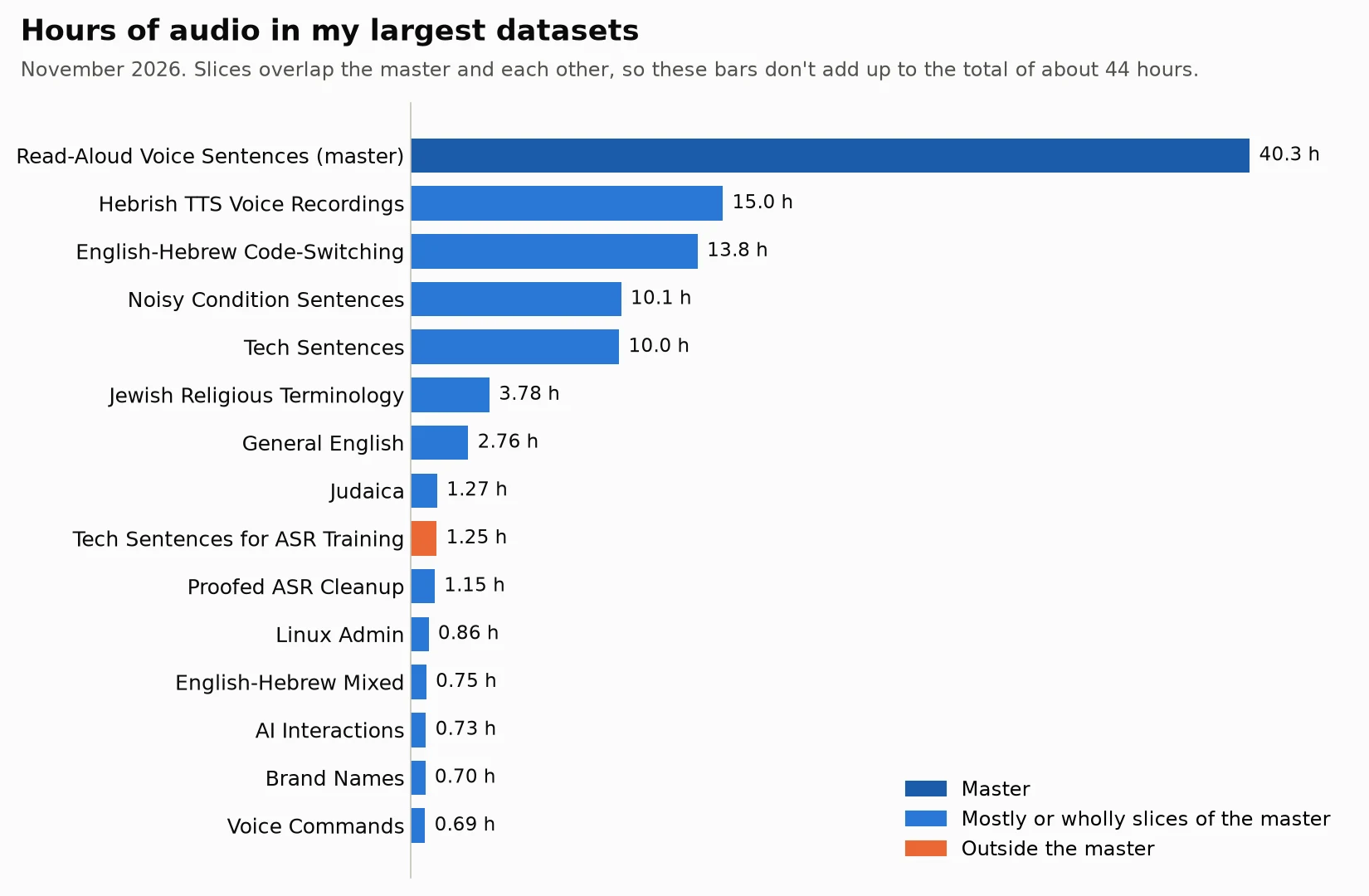
Most of these datasets are slices of the master: the same takes, filtered by topic or condition. One take can sit in several of them (a code-switched sentence recorded on the street counts towards code-switching and towards noisy conditions alike). When I compared take IDs across the sets, the real total came out as the master plus about four hours that never went through it.
How the hours split
With that caveat in mind (these overlap, so please don't add them up), here are the biggest sets:
Read-Aloud Voice Sentences, 40.3 hours: the master, gated.
Hebrish TTS Voice Recordings, 15 hours: speech for training a text-to-speech voice that code-switches between English and Hebrew.
English-Hebrew Code-Switching Sentences, 13.8 hours: English with everyday Hebrew words and Israeli names mixed in.
Noisy Condition Sentences, 10.1 hours: every take recorded in noise, nearly all of them outdoors.
Tech Sentences, 10 hours: software, DevOps, cloud and AI vocabulary.
Jewish Religious Terminology Sentences, 3.8 hours: Shabbat, the festivals, prayer and Talmud, in Latin letters.
General English Sentences, 2.8 hours: plain English with no Hebrew or tech vocabulary.
The four hours outside the master are mostly smaller, older or purpose-built: Tech Sentences for ASR Training (1.25 hours), around an hour of the TTS recordings, the Hebrish Validation benchmark (half an hour) and a few voice-note sets.
Hugging Face Dataset danielrosehill/Tech-Sentences-For-ASR-Training Write-up: Datasets for fine-tuning speech recognition on your own voice ↓ 418♥ 2Automatic speech recognitionMITUpdated Nov 2026 View dataset on Hugging Face Hugging Face Dataset Hebrish/Hebrish-Validation A validation benchmark for the Hebrish English-Hebrew code-switching speech recognition models (Sabich and the other lines). Each row is one continuous read of a fixed script of about one minute, with the script as the… ↓ 142Automatic speech recognitionCC-BY-4.0Updated Nov 2026 View dataset on Hugging FaceBelow that comes the long tail, and this is where it gets a little odd. There are 23 minutes of Irish English and 29 minutes of whispering. There are 16 takes of me singing sentences to any tune and six in a put-on voice. None of it will win any prizes, and the sets are tiny, but real dictation isn't delivered in a calm newsreader voice either.
Hugging Face Dataset Hebrish/Irish-English-Sentences ↓ 1kAutomatic speech recognitionCC-BY-4.0Updated Nov 2026 View dataset on Hugging Face Hugging Face Dataset Hebrish/Whispered-Sentences Audio dataset, split-out. Rows copied from the master, danielrosehill/Read-Aloud-Voice-Sentences, so one task can be browsed alone. Training reads the master, not this copy. How every dataset fits together: the dataset… ↓ 83Automatic speech recognitionCC-BY-4.0Updated Nov 2026 View dataset on Hugging Face Hugging Face Dataset Hebrish/Singing-Sentences Experimental. Short plain English sentences sung by one speaker, to any tune. text is the sentence as written, the transcript a robust recognizer should still give. ↓ 151Automatic speech recognitionCC-BY-4.0Updated Oct 2026 View dataset on Hugging Face Hugging Face Dataset Hebrish/Weird-Voice-Sentences Experimental. Plain English sentences read by one speaker in a put-on voice (very deep, squeaky, robot, cartoon, mock accent, mumbly). text is the sentence as written. ↓ 119Automatic speech recognitionCC-BY-4.0Updated Oct 2026 View dataset on Hugging FaceWhere it came from
The pace is what strikes me, looking at the timestamps. Only half an hour of the master predates October (an older set from November 2025, imported later). October added 21.6 hours and the first six days of November another 18.1, with the busiest day, 5 November, producing 4.7 hours of finished takes.
Almost all of it came through the internal microphone of one OnePlus Nord 3, and 7,120 takes were recorded outdoors. The rest is mostly a ThinkPad.
What these are good for
Every recording in the master is one speaker: me, an Irish accent living in Jerusalem. That's the point of the data and also its limit. It's excellent for adapting a model to my voice, and it says very little about anybody else's (any model scores measured on it rank models on me alone).
Where I think it's useful to others is as a worked example of what a personal speech dataset can look like, and how much of it you might need. Some sets are open and some are gated, so you'll need to request access for those on Hugging Face. The index marks which is which, and it also lists about six hours of older evaluation sets and experiments, which sit outside the 44-hour figure.
For the reasoning behind the sentences themselves, I wrote up the read-aloud datasets earlier this month. The numbers here will date quickly (the dataset grows most days), so the index is the place to check. If you end up recording your own voice, I'd love to hear how far you got before the novelty wore off.
