

On April 8th, 2026, Iran, the United States, and Israel announced a two-week ceasefire, mediated by Pakistan, France, and Egypt, following six weeks of open conflict that began on February 28th. I ran the Geopol Forecaster pipeline the following day to answer a straightforward question: will it hold?
The short answer: almost certainly not.
The chairman’s synthesis — the final probability after two independent analytical stages, six analytical lenses, and blind peer review — gave the ceasefire a 55% chance of surviving 24 hours, 22% at 72 hours, 10% at one week, and 4% at one month. The 90% credible interval at one month was 2-8%. Not one of the six analytical lenses gave it better than a coin flip beyond the first day.
(For background on how the pipeline works — the actor simulation, the six-lens council, the blind peer review — I wrote a separate post: Geopol Forecaster: An Open-Source AI Geopolitical Prediction Pipeline.)
A tactical pause, not genuine de-escalation
The core finding was unanimous across all six lenses: this ceasefire is a tactical pause, not genuine de-escalation. All parties are actively repositioning forces, conducting covert operations, and preparing for resumed hostilities while claiming compliance. The Lebanon scope ambiguity — Iran insists the ceasefire covers Lebanon, Israel explicitly denies it — isn’t accidental. Both sides continue operations while claiming the other is the violator.
The 72-hour window (April 11-13) was identified as the critical inflection point, driven by accumulated violations already underway (Hezbollah resumed 70 rockets on April 9th; the IDF conducted its largest airstrikes on April 8-9th), covert operations that appeared scheduled, Islamabad diplomatic talks failing to produce a joint statement, and Netanyahu’s trial resumption on April 13th (a historical escalation driver that the council flagged as underweighted by the simulation).
Where the two stages converged
The actor simulation — ten geopolitical actors making sealed-off decisions across four timesteps — independently converged with the council’s assessment. Stage A predicted roughly 55% survival at 24 hours and 28% at 72 hours; the chairman synthesised 55% and 22% respectively. That six-percentage-point convergence between two completely independent analytical methods was the most striking result of the run.
Both stages agreed on several high-confidence claims: Hezbollah is the most likely immediate trigger (they’ve never maintained an operational pause beyond 72 hours while under sustained attack); the Strait of Hormuz status is the sole genuine de-escalatory action (Iran maintains partial access at 10-15 vessels per day with fees, maintaining leverage without full closure costs); and Russian evacuation coordination from Iranian nuclear facilities is the single most important fresh data signal (suggesting Israel is planning a strike within 72-96 hours).
The dominant scenario: re-escalation by April 13th
The council assigned 60-65% probability to the ceasefire breaking and re-escalation following, most likely by April 11-13. Three sub-pathways were identified. A Hezbollah cascade (45% of breaks): a 100+ rocket barrage at Haifa triggers Israeli retaliation, which triggers Iranian ballistic missiles at Israeli bases within 24 hours. A Mossad sabotage trigger (35% of breaks): an operation targeting Natanz nuclear facility, with Iranian attribution within 6 hours and retaliatory missile strikes by that evening. And a Netanyahu trial escalation (25% of breaks): a major Lebanon operation ordered on April 12-13 to dominate news before trial resumption.
The remaining probability splits roughly evenly between the ceasefire holding and normalising into an actual diplomatic process (15-20%) and freezing into an unstable stalemate with continued proxy activity and no diplomatic progress (15-20%).
The critical uncertainty: Mojtaba Khamenei
The single highest-impact uncertainty the council identified was the functional status of Mojtaba Khamenei. British media reported on April 6th that he is incapacitated and receiving medical treatment; Iranian state media published a written statement on April 9th (which the council flagged as insufficient evidence, since it could be pre-recorded). The IDF assessed the “new Iranian regime” as even more extreme. The council assigned 60% probability to incapacitation.
This matters enormously because if Mojtaba is functional, he restrains IRGC hardliners and the 72-hour survival probability rises to about 35%. If he’s incapacitated, the hardliners (Vahidi, Aliabadi) are in control and the 72-hour probability drops to about 10%. The watch indicator: a video appearance (not written statement) by April 12th.
Key predictions
The chairman’s report produced a set of specific, time-bound predictions: Mossad executes sabotage at Natanz within 72 hours (65% probability). Iran launches 20-50 ballistic missiles at Israeli targets within one week (52%). The US launches direct strikes on Iranian IRGC or oil infrastructure within one month (55%). Israel strikes Iranian nuclear facilities with bunker-busters within one month (48%). Iran announces 90% uranium enrichment within one month (42%). Full Strait of Hormuz closure within one month (28%).
These are, obviously, predictions generated by an AI pipeline running on open-source data — not intelligence assessments. But the methodology (two independent analytical stages, blind peer review, explicit convergence and divergence analysis) at least forces the kind of structured reasoning that most punditry skips. Time will tell whether the probabilities were well-calibrated.
The full forecast data — simulation transcripts, all six lens analyses, blind peer reviews, frozen news bundle, and the chairman’s report — is published at github.com/danielrosehill/Iran-Israel-Ceasefire-Prediction-090426.
GitHub Repository danielrosehill/Iran-Israel-Ceasefire-Prediction-090426 Open-sourced geopolitical forecast: Iran-Israel-US ceasefire durability assessment (09/04/2026). Two-stage pipeline (Snowglobe + LLM Council) with 38-actor simulation and 6-lens analytical panel. PythonUpdated Apr 2026 View on GitHubForecast visualisations
The following charts were generated as part of the forecast run.
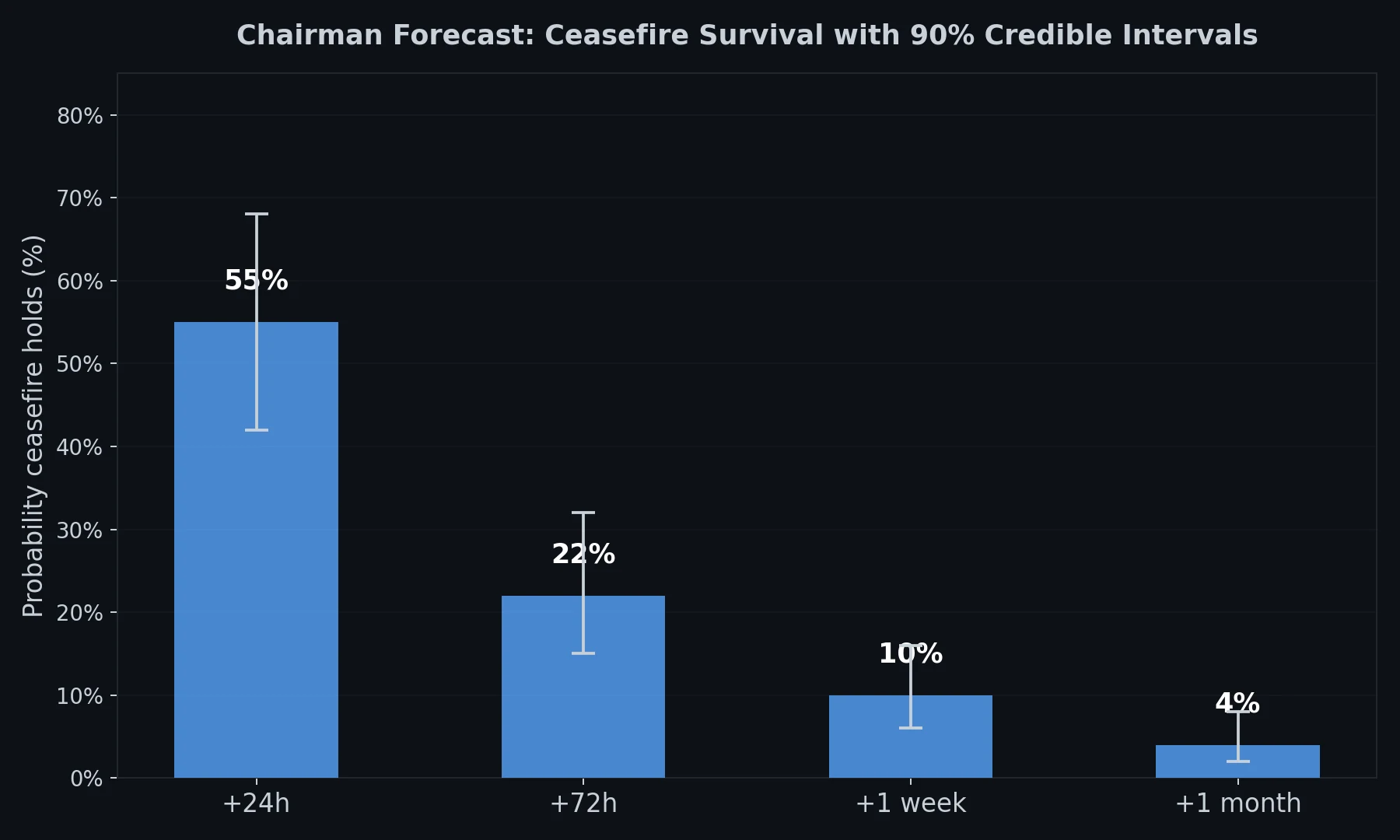
Chairman’s headline forecast across all time horizons.
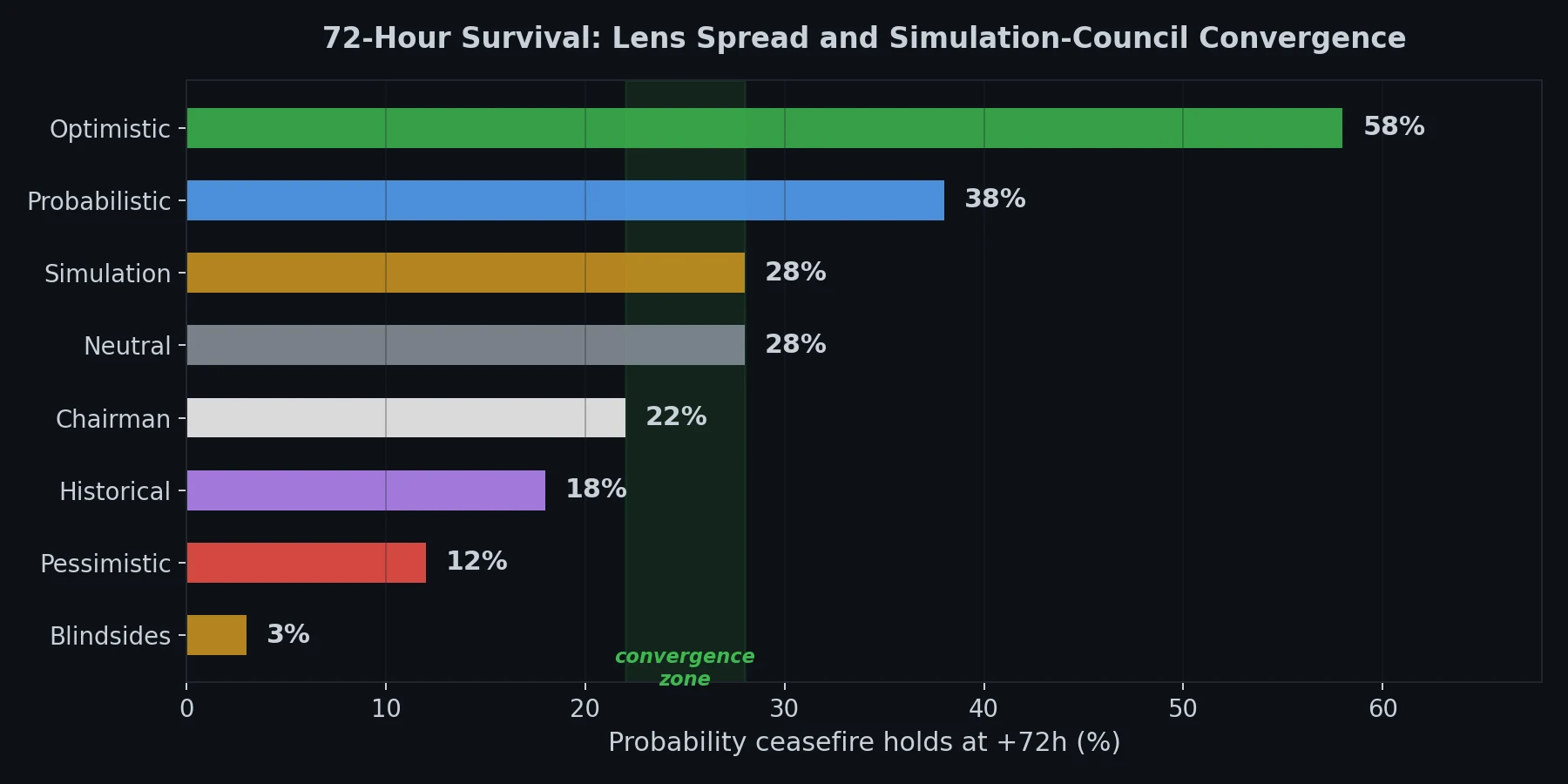
72-hour convergence between simulation and council.
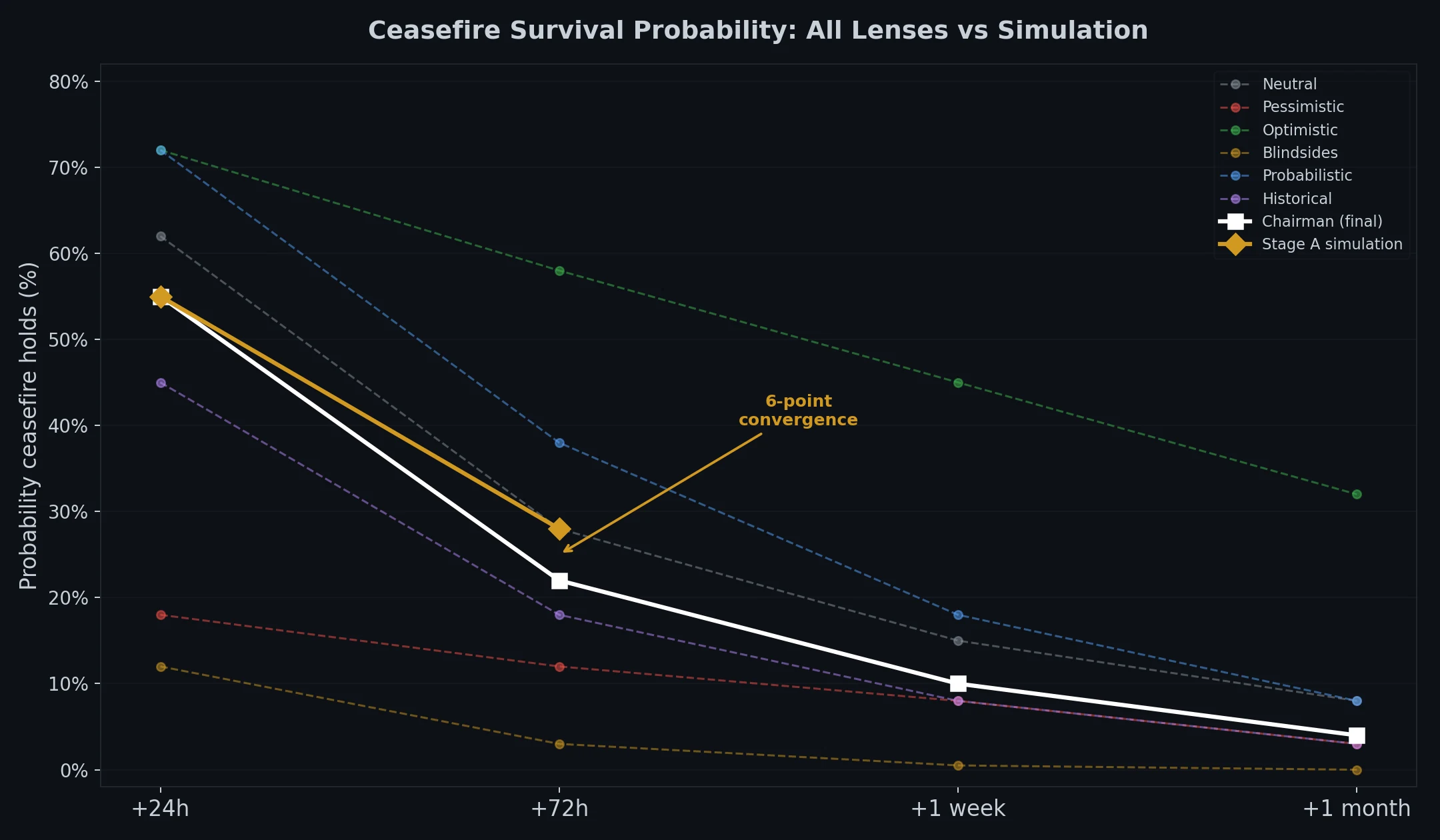
Probability estimates across all six analytical lenses.
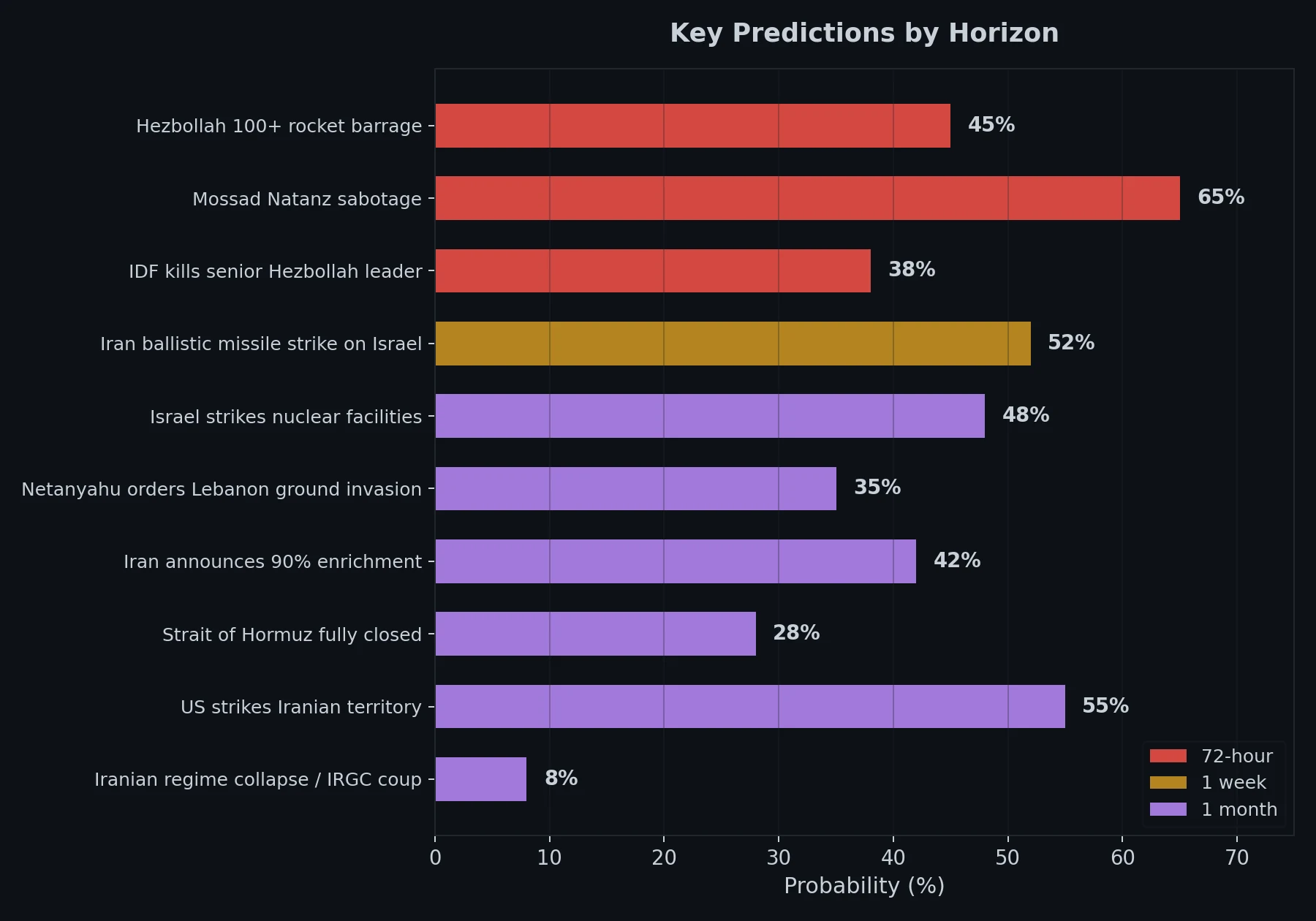
Key predictions with probability and confidence ratings.
Download the full report
The chairman’s full report is available as a PDF: Download Chairman’s Report (PDF). This includes the full probability analysis, convergence findings, key predictions, and uncertainty assessment.
The stack
Geopol Forecaster is built on two key open-source projects and a handful of supporting tools:
Stage A (Actor Simulation): IQTLabs/snowglobe — an open-ended wargaming engine from In-Q-Tel’s research lab, featuring persona-driven actors and referee adjudication. Published alongside a peer-reviewed paper and featured in a CIA Center for the Study of Intelligence publication (December 2025).
GitHub Repository IQTLabs/snowglobe Open-ended wargames with large language models ★ 61PythonApache-2.0Updated Feb 2026 human-ai-teaminglarge-language-modelsmulti-agent-systemstabletop-exerciseswargames View on GitHubStage B (Analytical Council): karpathy/llm-council — Andrej Karpathy’s 3-stage deliberation protocol with parallel query, blind peer review, and chairman synthesis.
GitHub Repository karpathy/llm-council LLM Council works together to answer your hardest questions ★ 25.7kPythonUpdated Nov 2025 View on GitHubLLM: Claude Sonnet 4.5 via OpenRouter (single model, single router — diversity comes from prompt engineering, not model switching)
Orchestration: LangGraph with SQLite checkpointing
GitHub Repository langchain-ai/langgraph Build resilient agents. ★ 43.6kPythonMITUpdated Oct 2026 agentsaiai-agentschatgptdeepagents View on GitHubNews: Tavily search + RSS/ISW feeds, frozen into a single shared bundle
Memory: Pinecone vector archive for cross-run semantic retrieval
The full pipeline code is open source: github.com/danielrosehill/Geopol-Forecaster.
GitHub Repository danielrosehill/Geopol-Forecaster Experimentary prediction analysis for real world events (Iran Israel) ★ 6PythonUpdated Apr 2026 ai-agentsgeopoliticsiran-israel View on GitHub