If you're an English speaker living in Israel, you probably don't speak pure English any more. I certainly don't. On any given day I'll tell my wife that I need to stop at the makolet, that the arnona bill came, or that I spent the morning on hold with Bituach Leumi (an experience that deserves its own blog post, frankly).
Updated 21 October 2026: brought up to date with the current models (Jachnun v1.0 and Sabich v1.0) and apps. The separate posts about earlier versions are folded into this one. The project's home is hebrish.app.
I also do a lot of my writing by voice. Speech-to-text has become very good at English over the past couple of years, but every time I dropped one of those Hebrew words into a sentence, the result fell apart. My trip to the makolet would come out as a trip to the "Micollette". Kartis ashrai (credit card) became "Cartisa Shrai". A bag of garinim became a bag of "Gary Neem", who I'm sure is a lovely person, but wasn't who I meant.
So I decided to fix it. The project is called Hebrish, and this post explains what I built, why, and how you can try it (no technical background needed).
Download
Hebrish is free for Android, Linux and Windows. The apps download a model themselves (about 660 MB, once) and then work entirely on your own device, so your dictation isn't sent off to anyone's servers.
-
Android
Hebrish for Android (APK, latest version)
Hebrish-latest.apk
You'll need to allow installing apps from outside the Play Store, or add the Hebrish F-Droid repository, which keeps it updated.
- Linux (Ubuntu) Hebrish desktop (.deb, latest version) hebrish-latest-amd64.deb
-
Windows
Hebrish desktop (portable .zip, latest version)
Hebrish-latest-windows-x64.zip
Unzip it and run Hebrish.exe.
These links always fetch the newest release. The desktop app types where your cursor is with a hotkey, shows text as you talk, and has a microphone level meter and a choice of models. All the releases and source code are on the Hebrish GitHub page; what changed in each release is on the changelog. If something doesn't work, tell me.
GitHub Repository Hebrish-ASR/Hebrish-App Hebrish apps for Android, Ubuntu and Windows: on-device English dictation that writes Hebrew words correctly. Runs Jachnun (English-Hebrew code-switching) or Sabich (code-switching + tech vocabulary), fine-tunes of NVIDIA Parakeet TDT 0.6B v2, or stock Parakeet. ★ 1PythonMITUpdated Oct 2026 View on GitHubTry the live demo
If you'd rather hear the difference before installing anything, this side-by-side demo runs the standard model and the fine-tuned one on the same recording. Record a sentence with a few Hebrew words in it, upload a clip, or pick one of the examples.
You can also try it in your browser on hebrish.app, with nothing to install.
What is code-switching?
Linguists call it code-switching: moving between two languages within a conversation, often within a single sentence. Everybody else in the Anglo community just calls it "Hebrish".
It isn't laziness or a lack of vocabulary. Some words simply don't have a good English equivalent, or the Hebrew one is the word everyone around you actually uses. Nobody in Jerusalem says "national insurance institute" out loud. You say Bituach Leumi, and the person you're talking to knows exactly what you mean.
The trouble is that voice recognition models are trained on one language at a time. An English model has never heard teudat zehut or rishayon iski, so it does the only thing it can do: it guesses at whatever English words sound closest. That's how you end up with "Ms Rada Chutz" when you said Misrad HaChutz.
Why English and Hebrew?
Because that's how I (and a great many other immigrants) speak. Organisations like Nefesh B'Nefesh have helped bring a large English-speaking community to Israel, and many of us live our lives in exactly this mix: English at home and in work email, Hebrew words for everything to do with the bureaucracy, the shuk, the bank, the school and the army.
Voice typing is more than a convenience for a lot of people. It's an accessibility tool for anyone with a disability, RSI or poor eyesight, and it's simply faster than thumb-typing on a phone. Speech-to-text that falls over every time you mention your kupat cholim isn't much use to that community.
What I built
I took an existing open speech recognition model, Parakeet, made by NVIDIA and already excellent at English, and taught it Hebrew words. In the jargon, this is called "fine-tuning": you don't build a model from scratch, you give an existing one extra lessons in the area where it's weak.
The model writes Hebrew words in English letters, in a consistent spelling (teudat zehut, mezuman, Machane Yehuda). That's how most of us type these words in English messages anyway, so the output drops straight into an email or a WhatsApp.
The models are named after Israeli foods:
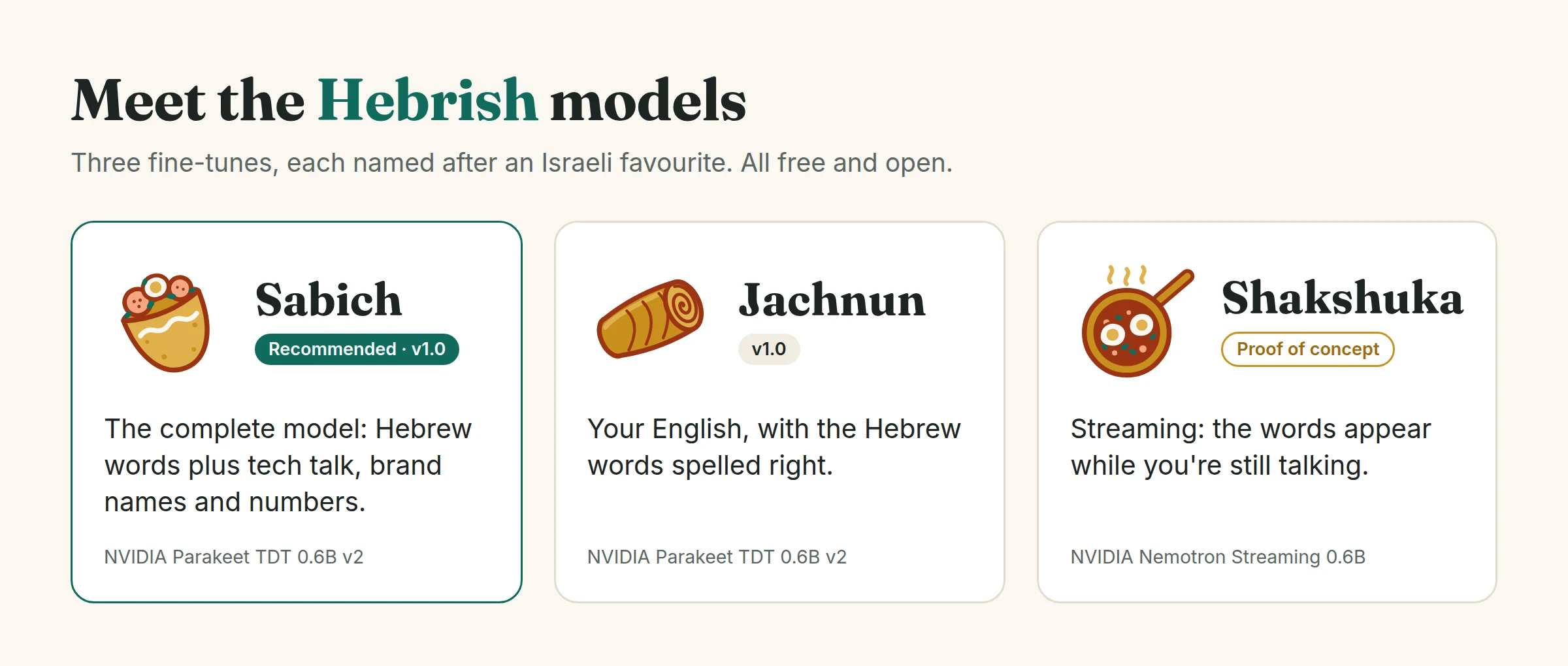
Sabich, the pita with a bit of everything, is what the apps recommend: Parakeet taught English with Hebrew words, plus tech vocabulary, brand names and numbers. The current release is Sabich v1.0. Sabich on hebrish.app.
Jachnun is trained on the Hebrish recordings alone, and was the first stable release. The current release is Jachnun v1.0; the five checkpoints before it were proofs of concept (PoC-1 to PoC-5), which earlier posts here called v1 to v5. The two are close: if one isn't giving you good results, try the other. Switching takes a tap. Jachnun on hebrish.app.
Shakshuka is the streaming line, built on NVIDIA's Nemotron streaming model, so text can appear while you're still speaking. It's still a proof of concept (Shakshuka PoC-2) and not in the apps yet. Shakshuka on hebrish.app.
Whisper Hebrish is where the project started, in November 2025: a fine-tune of OpenAI's Whisper large-v3-turbo. Its small sibling, Whisper Hebrish Small ACFT, is sized for phones and runs in FUTO Keyboard on Android. Both on hebrish.app.
Jachnun and Sabich also come in the formats other tools use (ONNX, GGUF, and MLX for Apple silicon Macs), listed on hebrish.app/models.
Here are some real sentences from the test set: what the standard model wrote, and what the fine-tuned one wrote.
I said: "I need to pick up some batsal from the shuk before Shabbat." Standard model: "...some batzal from the shoot before Shabbat." Fine-tuned: correct.
I said: "Yes, you can pay with a kartis ashrai, but if you pay mezuman there's a small discount." Standard model: "...with the Cartisa Shrai, but if you pay him as Uman..." Fine-tuned: correct.
I said: "My sister spent three hours on hold with Misrad HaChutz and still got nothing." Standard model: "...on hold with Ms Rada Chutz..." Fine-tuned: correct.
I said: "Pick up the forms for the rishayon iski from Chana, and ask her about the vaad in her shikun while you're there." Standard model: "...the Rishayoniski from Chana and ask her about the Vad and Hershikun..." Fine-tuned: correct.
I said: "Remind me to listen to that interview on Kan about the new AI regulation, I want to send it to Yossi." Standard model: "...that interview on Cannes... send it to Yassi." Fine-tuned: correct.
I said: "Have you ever spent a Shabbat in Beitar Ilit with the family?" Standard model: "...in Baytar Elite..." Fine-tuned: correct.
(I'll admit that "Gary Neem" still makes me laugh. I'm going to miss him a little.)
How well does it work?
The short version: Jachnun makes fewer than half as many mistakes on Hebrish speech as the standard model, and gets Hebrew words right more than twice as often.
"Word error rate" is the standard way of scoring speech recognition: the share of words the model gets wrong. On 387 English recordings containing Hebrew words that it never trained on, it drops from 11.3% with the standard model to 5.1% with Jachnun v1.0. Hebrew words that also appear in training come out right 73% of the time, against 28% before. And Hebrew words it never heard at all come out right 48% of the time, against 26%, because it has learned how Hebrew sounds map onto English spelling.
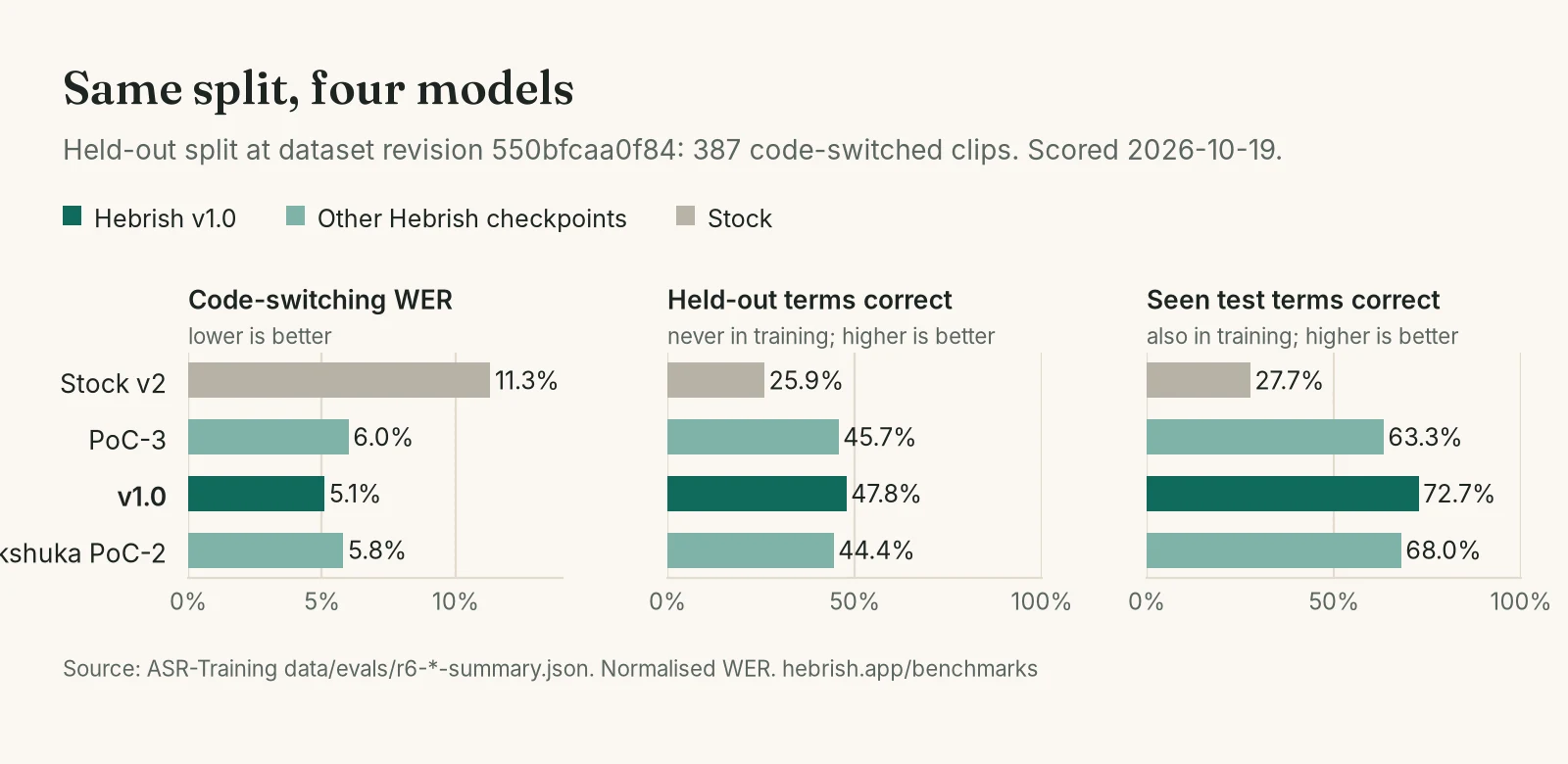
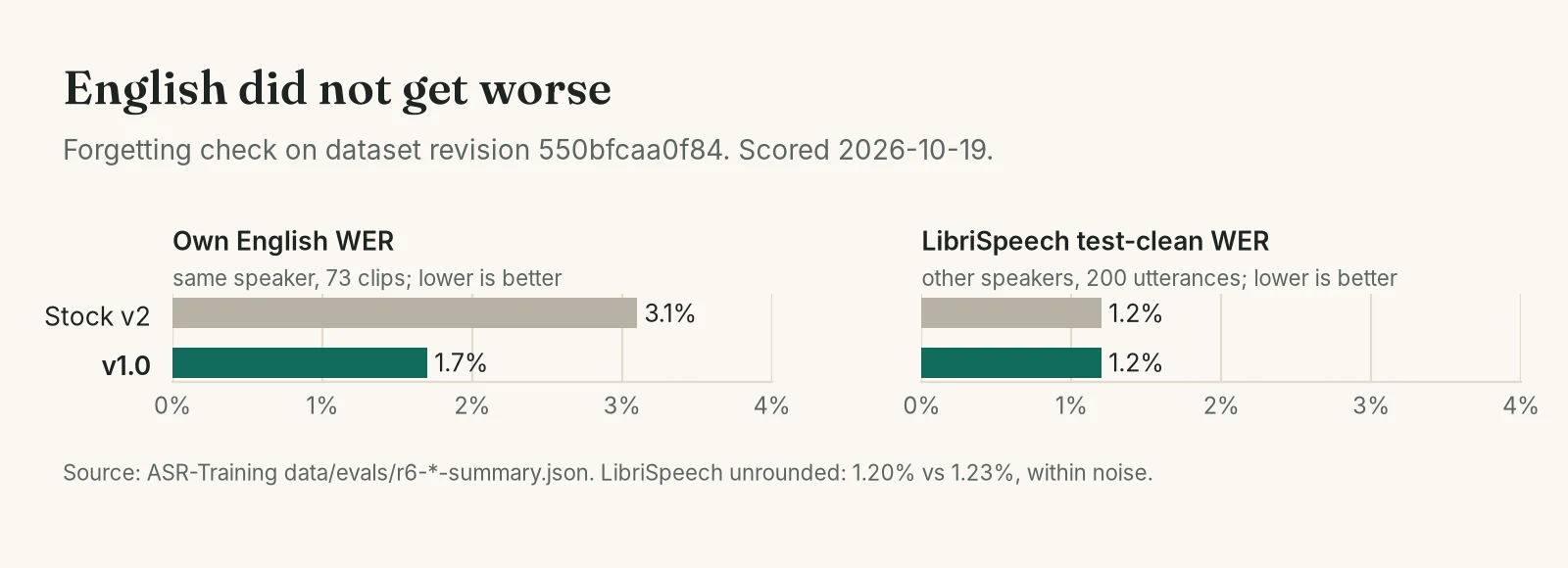
A common problem when you teach a model something new is that it forgets some of what it already knew. Here, ordinary English got better, not worse (1.7% errors on my own plain English, against 3.1% before), and on a standard English test read by other people it stayed where it was. That's because I deliberately mixed plain English recordings into the training.
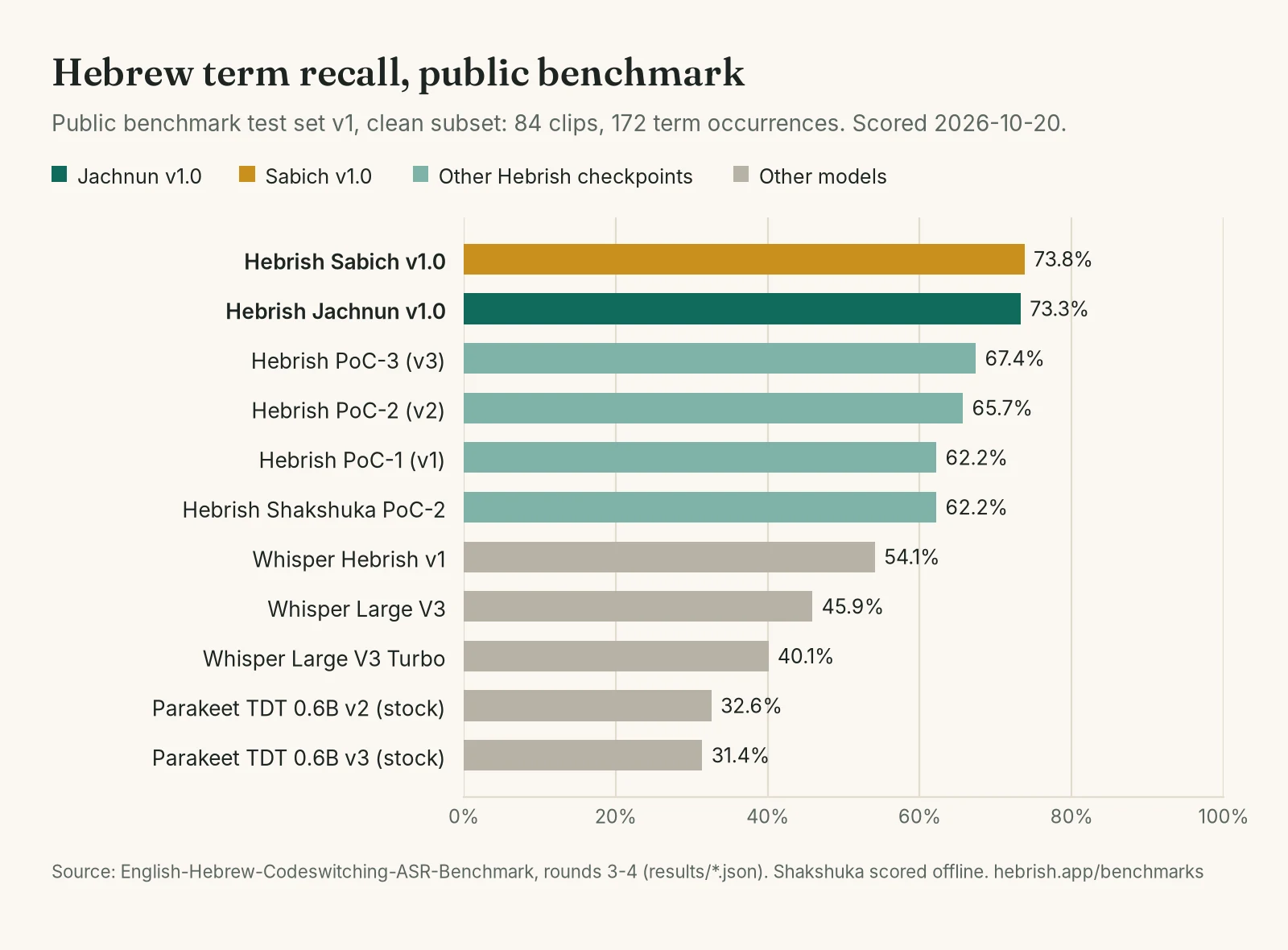
On a public benchmark I put together for English-Hebrew speech, Jachnun v1.0 gets 73.3% of the Hebrew words right and Sabich v1.0 73.8%, against 45.9% for OpenAI's Whisper Large V3 (the model behind a lot of the transcription apps you might already use) and 32.6% for the standard Parakeet.
On a newer, larger test round (422 recordings), Sabich v1.0 came out at 5.3% and Jachnun v1.0 at 5.4%, against 11.8% for the standard model. Every result, and how it was measured, is on hebrish.app/benchmarks. The technical story of the two models, from the data to the training settings, with the white paper to read or download, is in Jachnun and Sabich, in depth.
How it was made
For the curious, the recipe was quite simple.
Recordings: I recorded myself reading several thousand sentences aloud on my phone, using a small web app modelled on Mozilla's Common Voice. Each sentence mixes English with a Hebrew word or two, covering everyday life: government offices, food, places, religious life, banking, school and the army. I listened back to every take. Jachnun v1.0 was trained on 339 minutes of these (3,224 sentences).
The mix: about 70% Hebrish sentences, 20% my own plain English (95 minutes), and 10% of a standard English audiobook dataset, so the model doesn't lose its English.
Training: Jachnun v1.0 took 41 minutes on a single rented graphics card in the cloud. The limiting factor isn't computing power, it's how many hours I can spend reading sentences aloud.
Testing: the test sentences are kept separate from the training ones, and some of the Hebrew words in the test never appear in training at all. That's how we know the model is learning a skill and not just memorising a word list.
The recordings and the full write-up are on hebrish.app: the dataset and the Jachnun model card, with a white paper for the technical detail.
Limitations
It's worth being honest about these.
It's trained on one voice: mine. An Irish accent, a phone microphone, mostly quiet rooms. It should help other English speakers too, but I haven't measured how much. Recordings from other accents (American, British, South African, Australian) are high on my wish list.
One spelling per word. Hebrew words come out in one consistent English spelling. If you write chanukah and the model writes Hanukkah, that's a style difference, not a mistake.
Not every word yet. About three in four right is a big improvement on three in ten, but it isn't perfect.
What's next, and how you can help
Each new round of training adds recordings focused on what still trips it up: street names, brand names, place names and the like. (If Waze has ever misheard you asking for Rechov Emek Refaim, you know the problem.) Retrains of Jachnun will be v1.1, v1.2 and so on, and the apps pick them up by themselves.
This is where I'd love some help. If you use speech-to-text regularly and you have Hebrew words that it gets wrong again and again, suggest them on hebrish.app. A list of words is all I need. I'll write them into sentences, read them aloud, and they'll go into the next training round.
And if you try the apps, I'd love to hear how it does with your voice. That is the one thing I can't test on my own: send voice samples.
