
Israel votes for its 26th Knesset on 27 October. Five days out, I wanted to see what a forecast costs if you take the LLMs out of the loop entirely. Past attempts at AI election prediction I've seen (and run) have been expensive: a council of large models, each searching the web, then a judge model to reconcile them. This time I tried the opposite. Two small decision models, one frozen evidence pack, and a fixed bank of questions. The whole forecast cost $0.016.
The forecast is now on record. After the result is certified I'll score it, and the prediction markets, against what actually happened.
What a decision model is
Decision models (OpenRouter calls the endpoint "System One") don't write prose. You give them a block of evidence, the state, and a set of typed questions: yes/no, one-of-N, or ordered bins. They return probabilities. You're billed only for input tokens, about $0.04 per million on the cheapest model. Every question in a request shares a single billing of the state, so asking 39 questions costs about the same as asking one.
I used two with clearly separate lineages:
Clef (
cloudflare/clef), Cloudflare's post-train of an open Qwen model;Jev 1.14 (
typesafe/jev-1.14), TypeSafe's closed model.
There was no LLM anywhere in the run and no judge. Each model's answers stand on their own.
The evidence pack
Each model got the same pack of about 25–29k tokens. It's built from three datasets I put together and published on Hugging Face for this:
the outgoing 25th Knesset, members and factions;
the 38 lists and 1,361 candidates registered with the Central Elections Committee;
On top of that went the election rules and a facts-only news digest up to 22 October.
Every question was asked twice: once from that pack alone, and once with a section of Kalshi and Polymarket prices added. That second condition is the interesting one.
The 39 questions cover only the election itself:
who comes first, second and third;
seats for each of 13 lists;
whether the two blocs reach 61;
which of the smaller lists cross the 3.25% threshold;
turnout;
who ends up prime minister.
Some questions ask for the same thing in two forms, which lets me check whether each model agrees with itself.
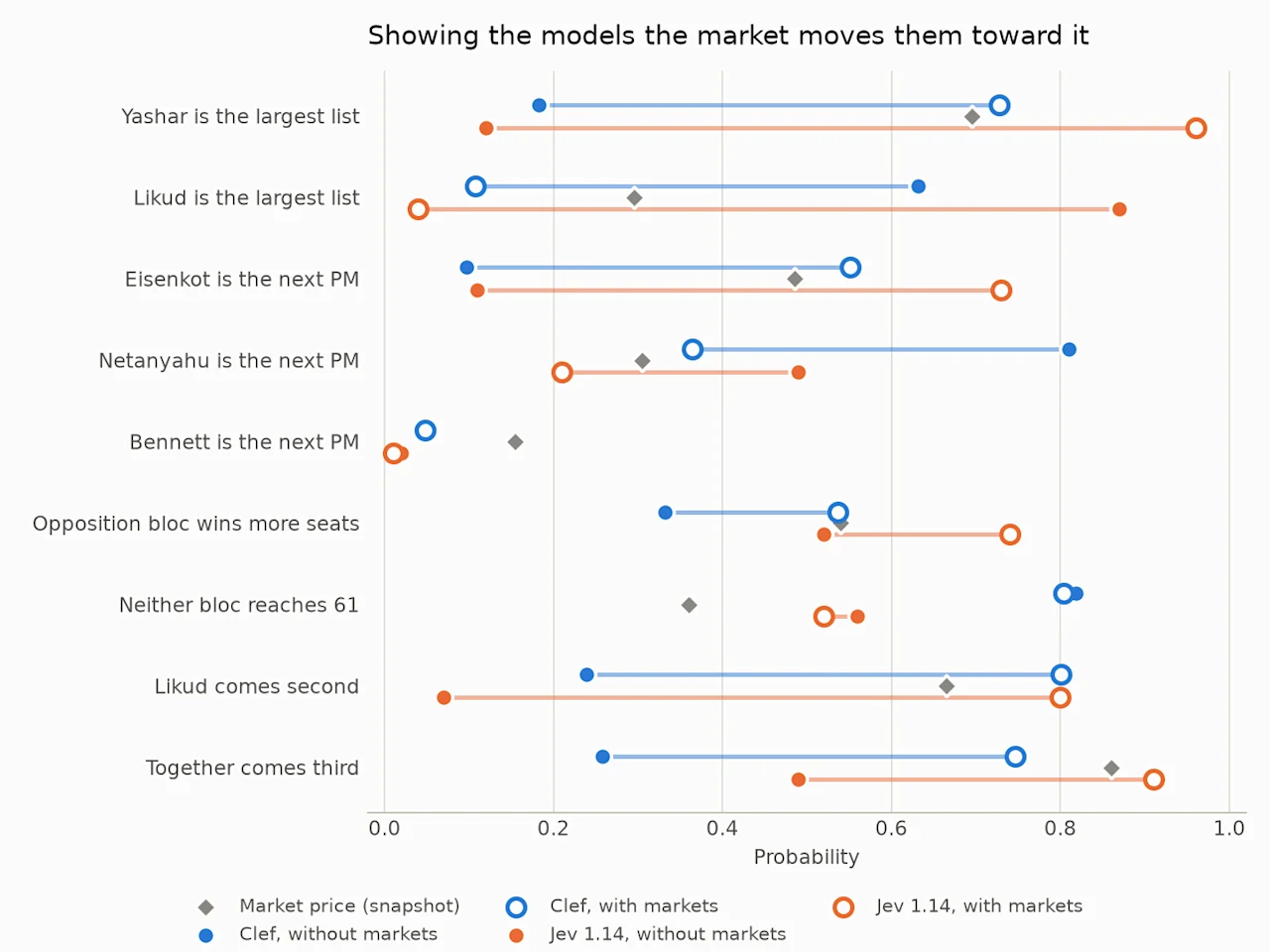
Finding 1: add market prices and the forecast flips

From the polls and news alone, both models favour Likud and Netanyahu:
Likud as the largest list: Clef 0.63, Jev 0.87.
Netanyahu as the next PM: Clef 0.81, Jev 0.49.
Add the market prices and both flip:
Yashar as the largest list: Clef 0.73, Jev 0.96 (Polymarket 0.69).
Eisenkot as the next PM: Clef 0.55, Jev 0.73 (market 0.49).
The polls are identical in both conditions, and as the next chart shows, neither model's seat estimates move much. So the headline call is coming almost entirely from the market section. Both models also went past the market rather than settling at its price. If the market is wrong, the market-informed forecast will be wrong with it, and more confidently.
Finding 2: the seat estimates are sensible

On seats, Clef sits within about a seat of the mean of the 24 polls published since 8 October, for every list. For the two largest lists:
Likud: polls 23.2; Clef 24.2 without markets and 23.0 with; Jev 28.5 without and 24.8 with.
Yashar: polls 21.5; Clef 20.3 and 21.1; Jev 20.9 and 21.3.
Jev without markets is the outlier. Its extra Likud seats explain its 0.87 for Likud as the largest list.
Finding 3: two lists probably miss the threshold

The two genuinely borderline lists both come out more likely to fail than pass:
The Reservists and the Economic Party: 0.30–0.38 to pass (Kalshi 0.46).
Amcha Yisrael: 0.09–0.27 to pass (Kalshi 0.26).
Every list polling above about five seats is at least 0.81 to get in.
The one clearly absurd answer of the run came from Jev without markets. It gave Noam, which polls at zero, a 0.53 chance of passing.
Finding 4: a hung Knesset, and Clef is the more coherent model

Clef puts the chance that neither bloc reaches 61 at about 0.8. That's what the polls say: both blocs sit near 53, with the Arab lists holding the balance. The market says 0.36.
Jev is noisier. Across 12 pairs of questions that ask for the same probability in two forms, the average gap between the two answers was:
Clef: 0.08–0.10;
Jev: about 0.20.
Two of Jev's worst cases:
Asked to pick the largest list, it gives Yashar 0.12. Asked as a yes/no question whether Yashar will be the largest list, it says 0.39.
It puts 0.80 on the Netanyahu bloc winning 61–63 seats, but only 0.54 on the bloc reaching 61.
What I take from it
Cost isn't the obstacle any more. Under two cents for 156 probability answers, with full provenance: every input file is hashed and the exact evidence sent is in the repo.
These models mostly read the evidence back. With market prices in the pack, they echo the market, and overshoot it.
Of the two, Clef is the one I'd trust. It's close to the polls, coherent, and produced no absurd answers.
One practical gotcha, for anyone trying this. Clef's cheapest host on OpenRouter silently truncates the state to 16,384 tokens. It returns no error; it just bills exactly 16,384 tokens and answers from the first part of the pack. I pinned Clef to DeepInfra and made the runner refuse any response billed at a context limit.
To explore every question, each model's answers and the full seat distributions yourself, there's an interactive version on Hugging Face.
Hugging Face Space danielrosehill/Israel-Election-2026-Forecast Decision models forecast Israel's 2026 Knesset election StaticLiveCC-BY-SA-4.0Updated Oct 2026 Open the SpaceThe full report (PDF), the question bank with each question's resolution rule, the evidence packs, the raw answers and the code are all in the Israeli-Elections-2026 repository. I'll come back after the result with the scores.
GitHub Repository danielrosehill/Israeli-Elections-2026 Modelling the 2026 Israeli Knesset election PythonUpdated Oct 2026 View on GitHub