
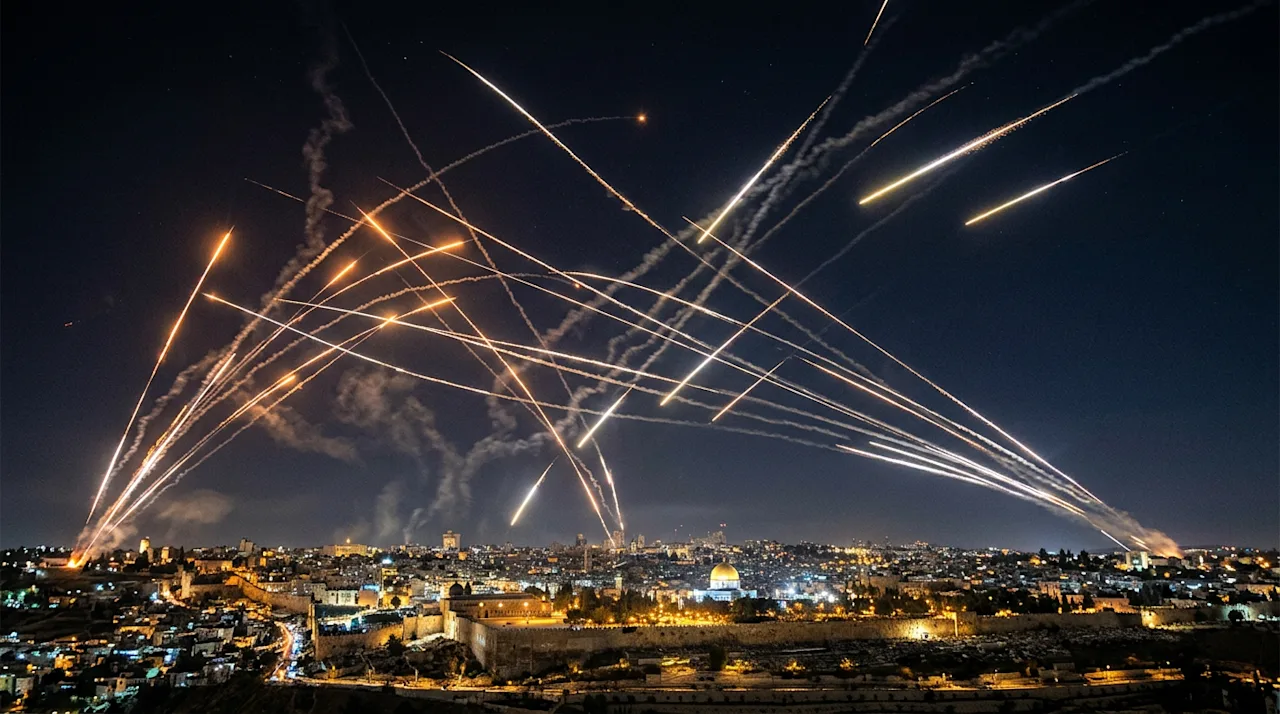
I became both morbidly fascinated and inspired, in equal measure, during the first of the Iranian waves of ballistic missiles targeting Israel. There have now been four discrete "events" — the Islamic Republic's "True Promise" operations. This is a personal account of what the first one was like, and what I learned about the physics involved by doing the only rational thing you can do in a bomb shelter at five in the morning: asking ChatGPT questions.
The First Wave
The first time it happened was kind of petrifying. The home front had no direct experience of Iranian missiles.
I had somehow managed to go on something of a news fast that weekend — which is out of character because my bedtime (and nighttime) routine is always bookended by scanning the news. I missed the whole story of how Iran was planning on launching missiles towards Israel. I began receiving frantic WhatsApp messages. I checked the news.
Getting to Shelter
The most memorable part of the evening: determining when the situation had reached that point at which you actually need to leave your house ASAP to go to shelter. For those who haven't lived through a situation like this, knowing when this tipping point has arrived is more difficult than you might expect because in the hours and days beforehand, the news is filled with a permanent chorus of talking heads speculating "what if" and you become kind of inured to the waiting.
You know you've gotten to the real thing when the Home Front Command fields somebody to go on the news permanently and he begins urging you to take shelter. I assumed this meant "you have a few minutes." I looked out the window and saw an entire sky filled with orange: interceptors launching upwards, missiles raining down. A sight I will never forget.
We got to shelter. But the government was unnervingly ambiguous as to when they said you have the all clear. So I stayed awake until seven in the morning. Like, I imagine, the entire country. Thank G-d for the incredible people who build and operate these defense systems.
ChatGPT-ing the Iranian Missile Program at 5AM
During the hours of waiting, I found a hotspot and began ChatGPT-ing the Iranian missile program. Because — what else do you do in a basement at five in the morning? My questions were very elementary: what's a "ballistic" missile? Is that the same thing as an ICBM? How high are we talking? How big? How fast?
As I did, I realised that these things are so big — in every dimension — that you have to reference them against something concrete. Unless you work in the military, "Mach 15" probably means not much to you (nor to me). It sounds fast. But how fast?
How Fast: Up to 15 Times the Speed of an Airbus A380
I asked ChatGPT to calculate the speed of each missile as a multiple of the max cruising speed of an A380. The fastest Iranian missile, the Fattah-2, travels at Mach 15 — roughly 5,100 km/h. An A380 cruises at Mach 0.85. That means the missile covers in one second what the airliner covers in about 20.

How Long: Five Minutes from Iran to Tel Aviv
At that speed, the roughly 1,000 km from western Iran to Tel Aviv takes approximately five minutes. An A380 flying the same distance would take just over an hour. Five minutes is the entire warning window — from launch detection to impact.

How Tall: Some Stand Taller Than a Six-Storey Building
Next question: how big? The Sejjil — one of Iran's most capable ballistic missiles — stands 18 meters tall. That's nearly twice the height of a three-storey building, or roughly six storeys. Even the smaller Kheibar Shekan, at 11.4 meters, would tower over a three-storey apartment block.

How Heavy: The Sejjil Weighs as Much as Nine SUVs
The Sejjil weighs 23,600 kg at launch. That's roughly nine Toyota Land Cruisers, or four African elephants. Even the "lighter" missiles like the Kheibar Shekan weigh in at nearly 6,000 kg — about the weight of two large SUVs.

How High: These Missiles Fly Through Outer Space
And how high? This is where it gets truly staggering. These missiles don't just fly through the sky — they fly through space. Their apogee — the highest point in their arc — is around 250 km. For context, commercial aircraft cruise at about 12 km. The Kármán line, the internationally recognized boundary of space, is at 100 km. The International Space Station orbits at 408 km. These warheads are re-entering the atmosphere from space.

As you begin to piece all of this together, I understood that even intercepting a single missile is essentially a miracle. Which is why the following morning I treated myself to a breakfast shawarma. Breakfast shawarma is highly recommended.
A Bullet Trying to Hit a Bullet in Outer Space
Think about it:
To intercept a ballistic missile, Israel — or the US or anybody — needs to hit an object in space (preferably) or kilometers in the sky which is: a) travelling at a multiple of the cruising speed of a commercial airline; b) which is actively attempting to change its course to evade detection (some missiles); c) which may be a decoy launched to waste an interceptor and make the real one harder to hit. The interceptor has to travel almost as fast. The combined velocity is almost unfathomable. And the margin for error is essentially zero.

It's a bullet trying to hit a bullet in outer space and if it misses by a hair's breadth an entire urban block could be decimated. The successful evasions we do see are inevitable but — also, this will sound a bit grisly — perhaps close to the better of the various horrible scenarios we could face.
The Invisible Heroes
I asked ChatGPT — maybe naively — what kind of people figure this stuff out? I mean, I assume their roles are classified. They're the invisible heroes here. I took two things from that aspect of the conversation: 1) we really need to keep investing in STEM and 2) I could probably learn Python (I'm still very mediocre but at the time it felt impossible). If people can figure out how to knock these things out of the sky and all that.
A Missed Opportunity in Communication
I still believe that there's a huge missed opportunity in communicating this. When I showed my ChatGPT visuals to a friend, the predictable reaction was "that can't be real." But basically it was. Non-proliferation people have been writing about this for years. But in PDFs, journals, at conferences. Sometimes a simple comparison, or frame of reference, can make the magnitude easier to grasp.
Note: Promise Denied is my project which uses AI to gather and structure data on Iranian ballistic missile assaults from open sources. The tracking data includes "True Promise" 1 through 4, capturing the salvos from the first wave through to the latest in this conflict. The data charts in this post are generated from that dataset. For the full interactive visualizations, see promisedenied.com/threats/physics. The conceptual illustrations (hero image, interception visualization) are AI-generated.
