
A few months ago I wrote up what I had done to my flat: moved the entire contents of a rented Jerusalem apartment onto industrial logistics standards, on the grounds that renting in Israel means moving often and involuntarily, and cardboard does not survive that. Euroboxes, pallets, picking bins, labels on everything. It worked.
Then I went to buy more boxes, and got stuck on a question I assumed would take about thirty seconds.
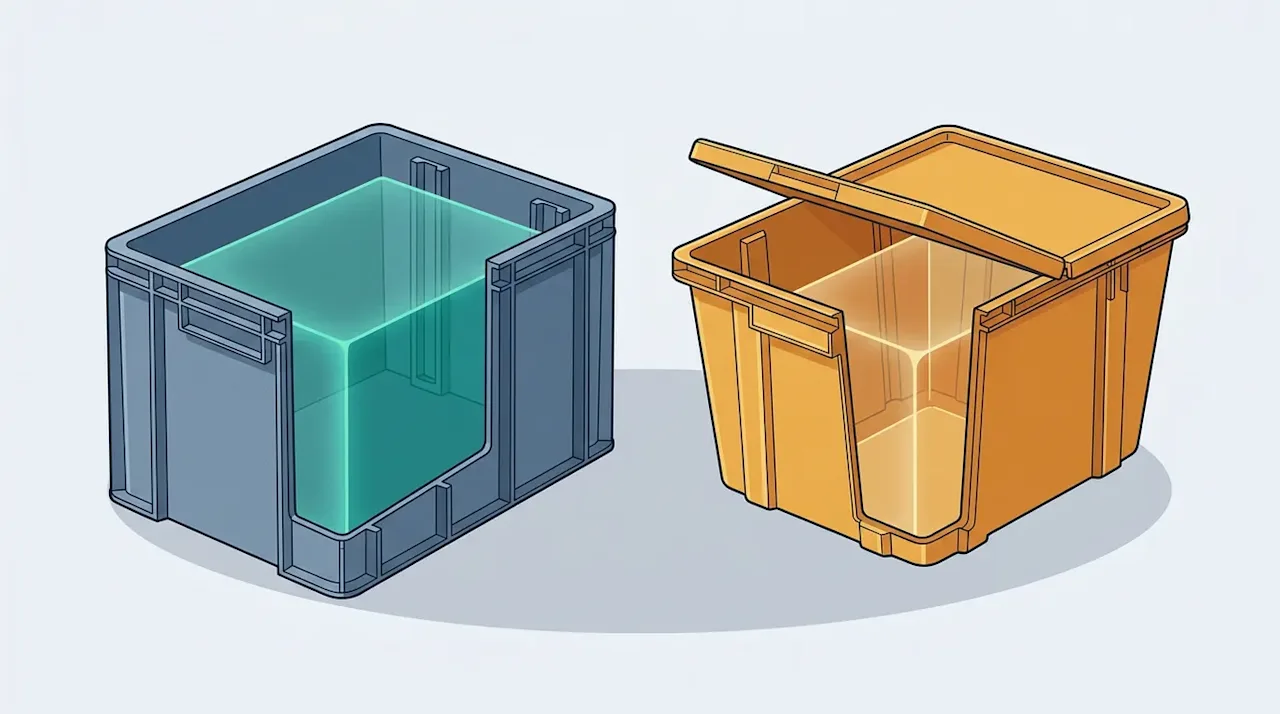
On the shelf beside the Eurobox I already own there is a thing called an attached-lid container — an ALC. Same 600 × 400 footprint. Roughly the same height. Sloping walls instead of straight ones, and a lid moulded onto the back so you can't lose it (which, if you have ever hunted for a Eurobox lid in a stairwell, is not nothing). Which of the two holds more?
Nobody publishes the answer.
The number on the box is not the number you get
Here is the shape of the problem, using the size I own most of. A 60 × 40 × 23 cm Eurobox. Multiply it out and you get 55.2 litres.
It holds 42.
The missing thirteen litres are wall thickness, moulded ribbing, the stacking rim around the top, and the feet on the base that stop one box sliding off another. About a quarter of what you thought you were buying is plastic doing structural work. This is not a swindle, incidentally (most vendors publish an honest capacity figure somewhere further down the page) — it is just that the number printed largest, the one in the product title, is the outside.
And the error is not the same size for both boxes
If the loss were a flat quarter everywhere you could ignore it. Compare on external volume, get the ranking right, move on.
It isn't flat. A straight-walled Eurobox gives back a median 78 % of its external volume. A tapered ALC gives back 71 %. That is seven percentage points, and it runs in one direction — always against the ALC, because sloping walls take their cut the whole way down the box (a straight wall only charges you once, at the perimeter).
Which means the intuitive comparison (same footprint, same height, so same box, surely?) systematically flatters the ALC by enough to change which one you buy. That was the moment this stopped being a shopping errand and became a weekend.
So I built the dataset I had wanted to find
Those two ratios are not folklore. They fall out of 121 individual product listings pulled from four vendors in four markets: Salesbridges in the Netherlands (69 listings, and the only vendor anywhere who publishes internal dimensions on almost everything they sell), Plastic Box Shop in the UK (31), Yosibox here in Israel (12) and Hudson Exchange in the US (9). Each row carries its own external dimensions, its own stated capacity, its price, and the date I captured it.
Median usable-to-external ratio: 78 % across the 101 Euro listings, 71 % across the 16 ALCs, 70 % across the three VDA KLTs. The gap holds across three independent supply chains, which persuades me a good deal more than any single vendor's spec sheet would.
On top of that sits a second table — 48 nominal sizes, one row each, with typical internal dimensions and a usable capacity you can actually plan against. Both are on Hugging Face under CC BY 4.0.
Hugging Face Dataset danielrosehill/storage-container-dimensions Planning-grade volumetric reference for the plastic containers that European and North American warehouses actually run on: Euroboxes (Euro stacking containers), attached-lid containers (ALCs), and VDA 4500 KLTs. ↓ 168CC-BY-4.0Updated Jul 2026 View dataset on Hugging FaceThe second table exists so you can audit the first. Every "typical" capacity is a judgement call about a spread of real products, and I would rather hand you the spread than ask you to trust the judgement.
The standards fix the outside. They say nothing about the inside.
This is the part that surprised me, and it is why the data did not already exist somewhere sensible.
ISO 3394 defines the 600 × 400 mm packaging module. EN 13199 caps a small load carrier at that footprint. VDA 4500 goes further and fixes three external heights for automotive KLTs — 147.5, 213 and 280 mm, and I do enjoy that somebody argued their way to the half-millimetre.
Not one of them specifies wall thickness, draft angle, rib design or base construction. Those are the manufacturer's choice. And those (obviously, once you say it out loud) are precisely the things that decide what the box holds.
So the whole edifice of standardisation that makes these containers interchangeable on a pallet — which is the point of them, and it works beautifully — stops at the surface. Inside, you are on your own.
Three vendors, one box, three different insides
Here is what "on your own" looks like. Take the plain 60 × 40 × 32 Eurobox, a size all three European vendors sell.
Salesbridges publishes 570 × 370 mm internal.
Plastic Box Shop publishes 555 × 355 mm.
Yosibox publishes 550 × 360 mm.
In litres that is a spread of 60 to 66 — an 11 % range on a box every one of them describes as 600 × 400 × 320.
And all three are telling the truth. A euro crate is itself very slightly tapered (a couple of degrees, enough to help it out of the mould), so the top opening really is wider than the base. Salesbridges measured at the top; the other two measured nearer the bottom. There is no wrong answer here, which is somehow worse than there being one.
Every row in the dataset therefore carries vendor_capacity_low_l and vendor_capacity_high_l beside the typical figure, and the typical figure sits at or just below the conservative end on purpose. A planning number that overstates capacity fails silently — on moving day, in a stairwell, with the van already double-parked.
A short detour into what these things are called
While I was in there I fell into a naming hole, which I will summarise so you don't have to.
"KLT" is a real thing: Kleinladungsträger, the automotive returnable carrier on that VDA height grid. It is also used by at least one vendor as a garnish. Salesbridges titles fourteen ordinary open-top euroboxes "Euro Container KLT Box", at eight heights and on three footprints including 80 × 60, not one of which is on the VDA grid. Filter a catalogue by the word and you will collect euroboxes while believing you have automotive carriers.
"Tote" is worse. In American usage it is any industrial container, tapered or straight, lidded or not. In British usage it drifts towards the attached-lid product specifically. So "industrial tote" is a correct name for both families (and therefore a completely useless way to tell them apart, which is the sort of thing you discover only after building a filter around it).
The reliable test is boring and takes a second: straight walls or sloping, and does it nest when empty. A Eurobox does not nest. An ALC nests to about 75 %.
What the taper actually costs
Back to the original question, which now has an answer.
Same 60 × 40 × 34 cm external envelope: the Eurobox gives you 63.5 litres, the ALC about 60.7. Call it three litres, or four to five per cent. Budget nine per cent for the pessimistic case, which is what you get if you fold in the US-market totes and the small sizes where the walls are a larger fraction of everything.
Three litres. After all that.
It is less than I expected from a box you can visibly watch sloping, and there are two reasons. The taper only has to be steep enough to let the boxes nest, not to stack them like traffic cones, so it is a few degrees per wall. And the Eurobox is no paragon either — it loses 5 cm of length, 4.5 cm of width and 1.5 cm of height to its own walls and rim, which is where its own missing 22 % goes.
There is also a lovely wrinkle: nobody makes a 60 × 40 × 34 ALC. The sloping range at that footprint runs 25, 31, 36.7 and 40 cm, so the comparison I spent all that effort on is hypothetical. In a real purchase you are choosing between stepping down to the 31 cm ALC and giving up 7.5 litres against the Eurobox, or up to the 36.7 cm and gaining 1.5. On a 1.8 m stack the taller one still fits four layers, so it is usually the sensible swap.
And what the three litres buys
Which is where I changed my mind about the comparison entirely.
The lid is included. A separate 60 × 40 Eurobox lid runs about ₪23 in Israel and €3.95 at Salesbridges; on a ₪150 box that is 15 % of the purchase price, several times what three litres of air is worth to anybody.
And empty, they collapse. Twenty nested ALCs occupy 0.43 m³. Twenty empty Euroboxes occupy 1.63 m³, because a straight-walled box does not nest at all — it stacks, which is a different and much less useful trick once the boxes are empty (an empty Eurobox takes up exactly as much of your flat as a full one, a fact I have had ample opportunity to contemplate). If your boxes ever sit idle or travel back empty, that gap is roughly four times the size of the one everybody argues about.
The Eurobox wins where boxes stay full, live on shelving, and lids are either unnecessary or bought once. Choose on that. Not on the three litres.
Teaching the calculator to think in usable litres
I already had a calculator for this — a single-page thing that works out pallet loads and 20 ft container utilisation for a basket of boxes. It only knew about Euroboxes.
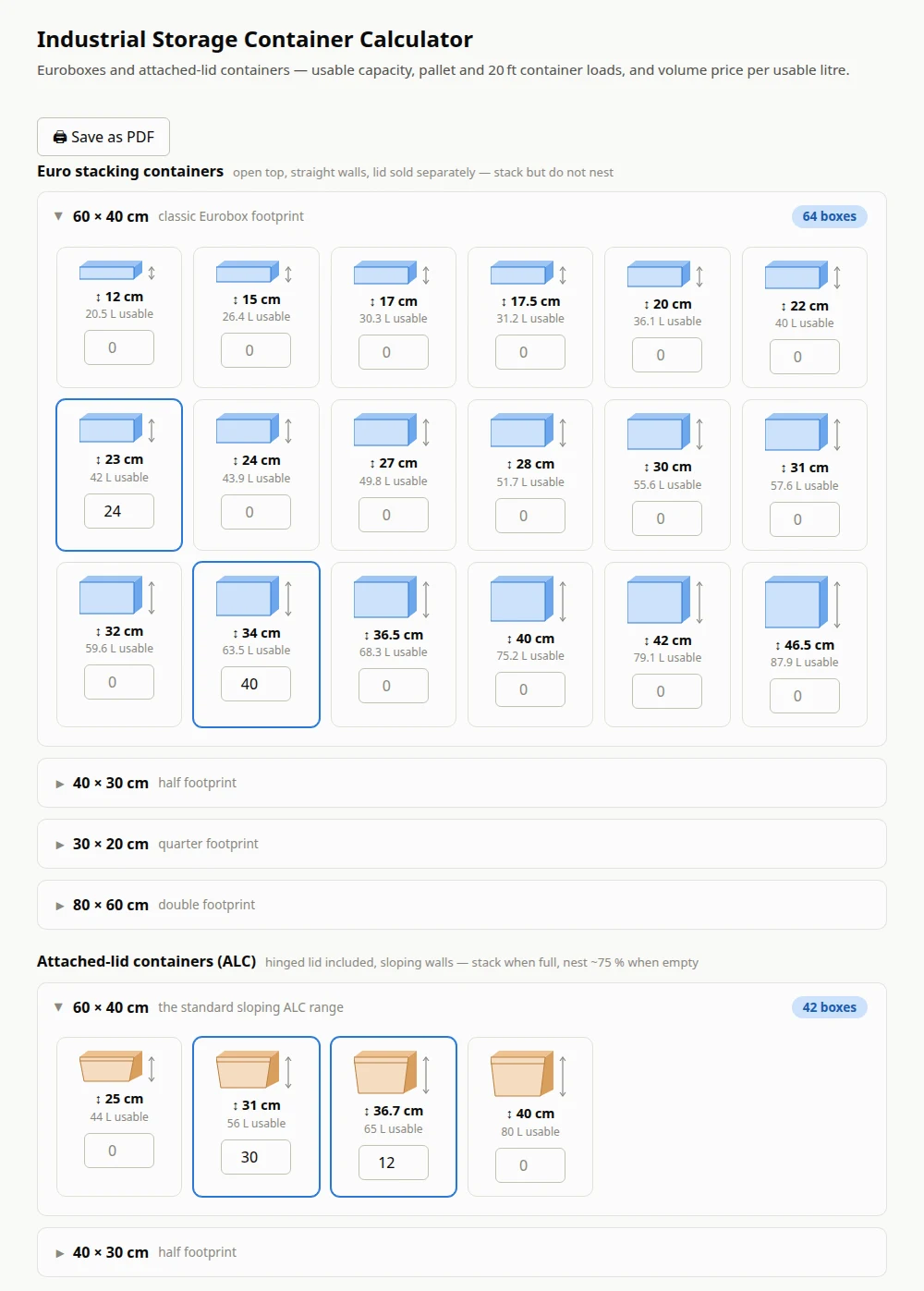
It now knows both families and keeps them apart everywhere, down to the colour of the pallet layer diagrams (blue for Euro, amber for ALC). More to the point, it prices a purchase on what I have taken to calling volume price: purchase price divided by usable capacity, quoted per usable litre.
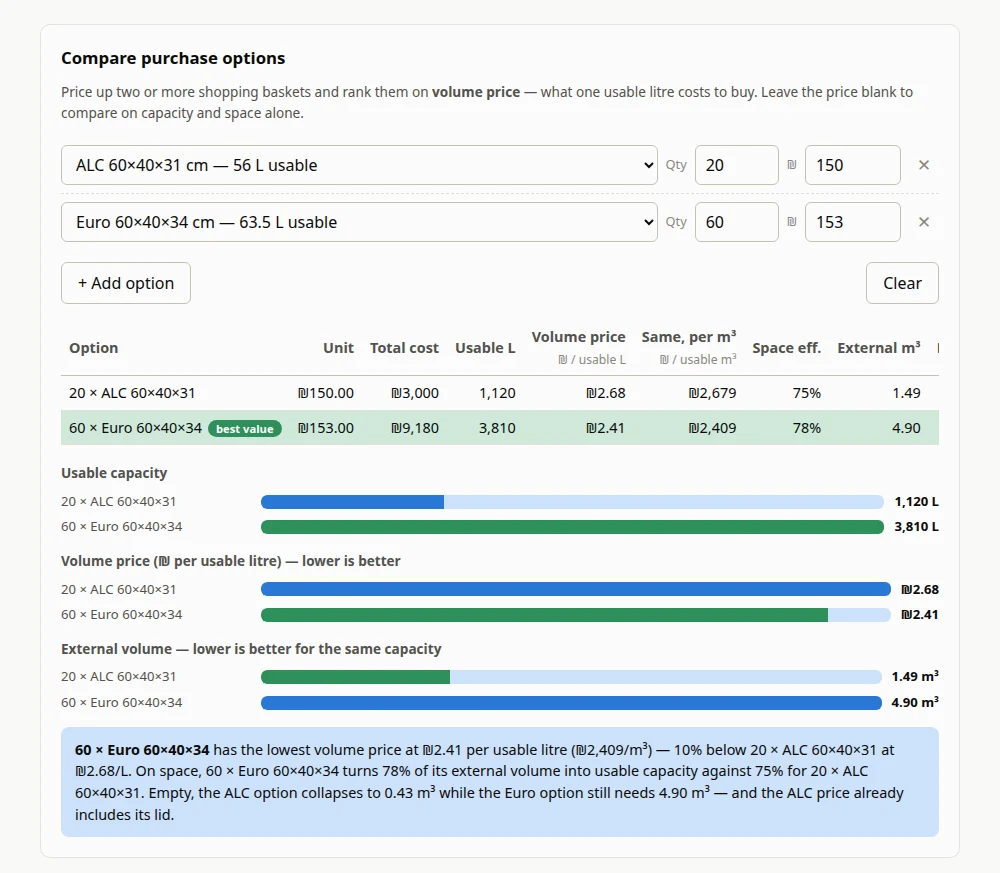
There is no industry term for that, as far as I can tell. Freight quotes per cubic metre, supermarkets call it unit pricing, box manufacturers quote per box and leave the division to you. Litres won as the unit because everything on the market lands between roughly 0.10 and 10 per litre in any major currency (per m³ you get four-digit numbers, and four-digit numbers all look the same at a glance, which defeats the purpose).
The worked example in the repo — the Eurobox price is a real Israeli retail figure, the ALC price is illustrative — ranks 60 Euroboxes at ₪2.41 per usable litre against 20 ALCs at ₪2.68. The Eurobox buys volume about 10 % more cheaply. And then the nesting figure sits directly underneath it, which is the whole point: the tool is not trying to hand you a winner, it is trying to stop you comparing the wrong quantity.
Renaming it was the irritating part. It was the Eurobox calculator; ALCs are not Euroboxes; the repository keeps its old name anyway so the GitHub Pages URL and the copy embedded in this blog don't break. Some debts you just service.
The rough edges, because there are some
I would rather flag these than have somebody find them.
The 400 mm ALC is an outlier. 80 litres nominal, which is 83 % of its external volume where the rest of its own range sits at 73–75 %. Either it really is less tapered or 80 is a generous round number. It is in the catalogue as published; don't read it as evidence that tall ALCs are efficient.
The 800 × 600 rows are the weakest set. Only one vendor publishes internal dimensions for that footprint, and their figures imply 8–9 % more capacity than my rule gives (thin-walled versions of that size are marketed at 134 litres where the rule says 124, so the rule is being cautious rather than wrong — but cautious by an unhelpful amount).
The Euro height series is not a standard at all. Unlike the three VDA heights it is whatever manufacturers converged on, which is why it is so irregular — 12, 15, 17, 17.5, 20, 22, 23 cm and onward — and why a handful of rows are interpolations into gaps rather than sizes I have seen for sale. Every row carries a listings_observed count so you can check before trusting one.
And the standing caveat: these are typical figures averaged across vendor catalogues, not specifications. Chasing manufacturer-exact numbers is not achievable in a general reference and would be obsolete the moment a mould changed. Use them to compare and to plan. Ring your actual supplier before a large order.
Why bother publishing the boring stuff
None of this is a hard problem. It is arithmetic on numbers that vendors already publish. The reason it took a weekend is that nobody had put them in one place, because there is no money in it and no standards body whose job it is.
Which is a decent argument for doing it anyway. A whole category of ordinary purchasing decision — households moving, small workshops kitting out, anyone buying more than about five boxes at once — gets made on a figure that is wrong by a quarter, and wrong in a direction that consistently favours one product over another. That is not a scandal (nobody is hiding anything; the honest numbers are right there on the same page, in smaller type). It is just a gap, and gaps are cheap to fill once somebody notices them.
It's CC BY 4.0. Take it.
Links
storage-container-dimensions — the dataset: 48 sizes, 121 vendor listings, CC BY 4.0
An 8-page printable reference — every size, its internal dimensions and the vendor spread, by family
The calculator — usable capacity, pallet and container loads, volume price (source)
The warehouse apartment — the post this one is a footnote to
