

The author at YosiBox, near Ashdod — the closest thing Israel has to a LEGOLAND for anyone who likes industrial storage.
We have rented in Israel for about ten years, and in that time we have moved more often than we ever chose to. One landlord wanted the flat back for his daughter; another ended our tenancy after we asked him to fix a leak.
None of it was bad luck — it is just how the market is built. Leases here are, in practice, fixed twelve-month terms with no right to renew, no rent control, and a broker fee (nominally the landlord's, routinely shoved onto the tenant) of a month's rent plus VAT.
A single forced move can cost the better part of three months' rent before you have paid a shekel to the new place.
Why the rental market forces the issue
To put a number on it: six moves in ten years here, about half of them driven by tenancy issues rather than by choice, with the rent always paid in full and on time. That isn’t bad luck — it’s the structure.
Israeli residential leases are, in practice, fixed twelve-month terms, commonly “12 + option 12.” At the natural end of the term a landlord is generally free not to renew, no cause required, and there is no general rent control; the older law that once gave strong protection (the 1972 Tenant Protection Law) is explicitly excluded from modern leases.
The 2017 Fair Rental Law (§§25א–25טו) added deposit caps and repair duties but left the core exposure — no security of tenure — untouched.
Then the costs stack. A single forced move can hit you for the better part of three months’ rent before you pay a shekel on the new place: a deposit capped at roughly three months (§25י), a broker fee of about a month’s rent plus 18% VAT, and the move itself.
The broker fee is the sharpest example of reform failing in practice — by statute (§25ט) it belongs to whoever hired the agent, almost always the landlord, yet it is routinely shoved onto the tenant, often unreceipted.
Somewhere like Germany designs this out (the Bestellerprinzip: whoever hires the agent pays, and leases are frequently indefinite). Israel does the opposite, and the market’s instability lands on the tenant. This whole project is, honestly, a radical reaction to a broken system.
You cannot fix that from your living room. But you can change what a move costs you — in money, in time, and in back pain.
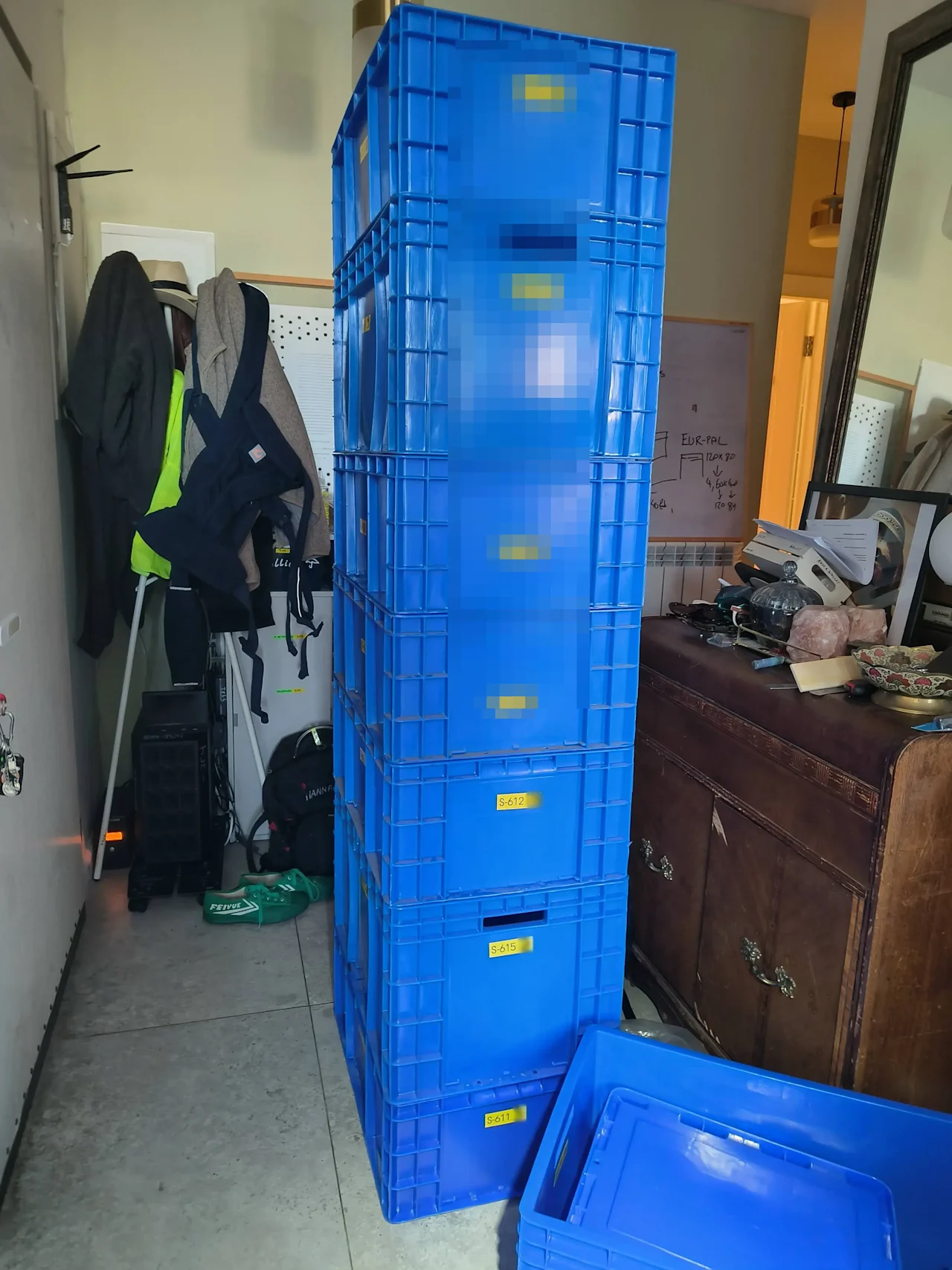
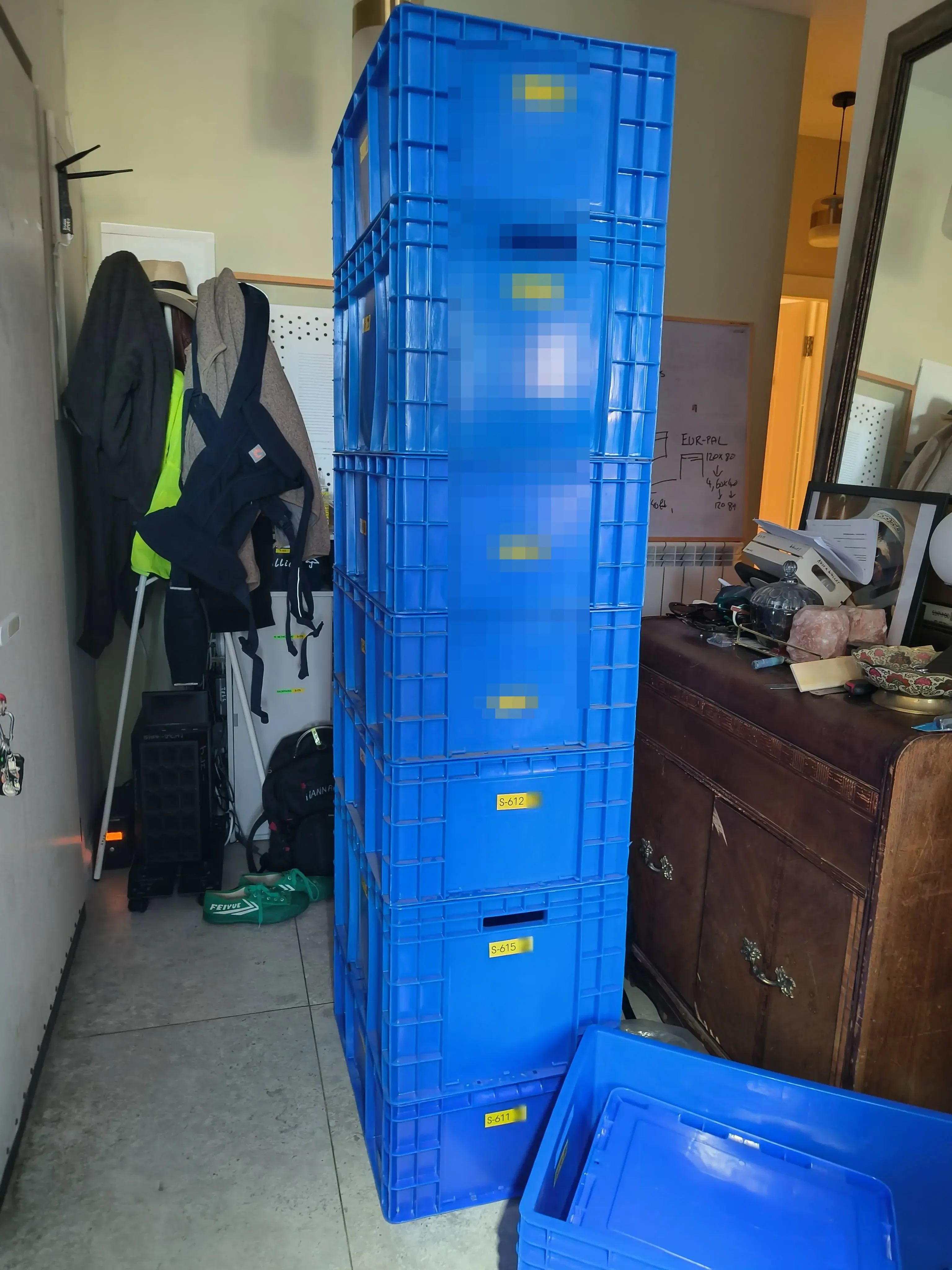
My answer turned out to be slightly absurd, and I have come to love it: I stopped buying consumer storage products and moved our whole household onto the same standardised containers that industry uses to move things at scale. Visitors ask whether it is a warehouse or an apartment. It is a running joke, and also a fair question.
The system in pictures
A few more from the last year — sourcing, storing, and moving the whole thing.


The thing nobody tells you: it is all one standard
The single most useful thing I learned is that industrial storage is not a pile of random products. It is a small number of interlocking dimensional standards, and once you know them, everything in the ecosystem fits everything else on purpose.

Stay on the grid and things tile with zero wasted space; go off-grid — which is where almost every consumer product lives — and you get gaps, wobble, and wasted volume.
The chain, from the box in your hand up to the lorry, goes like this:
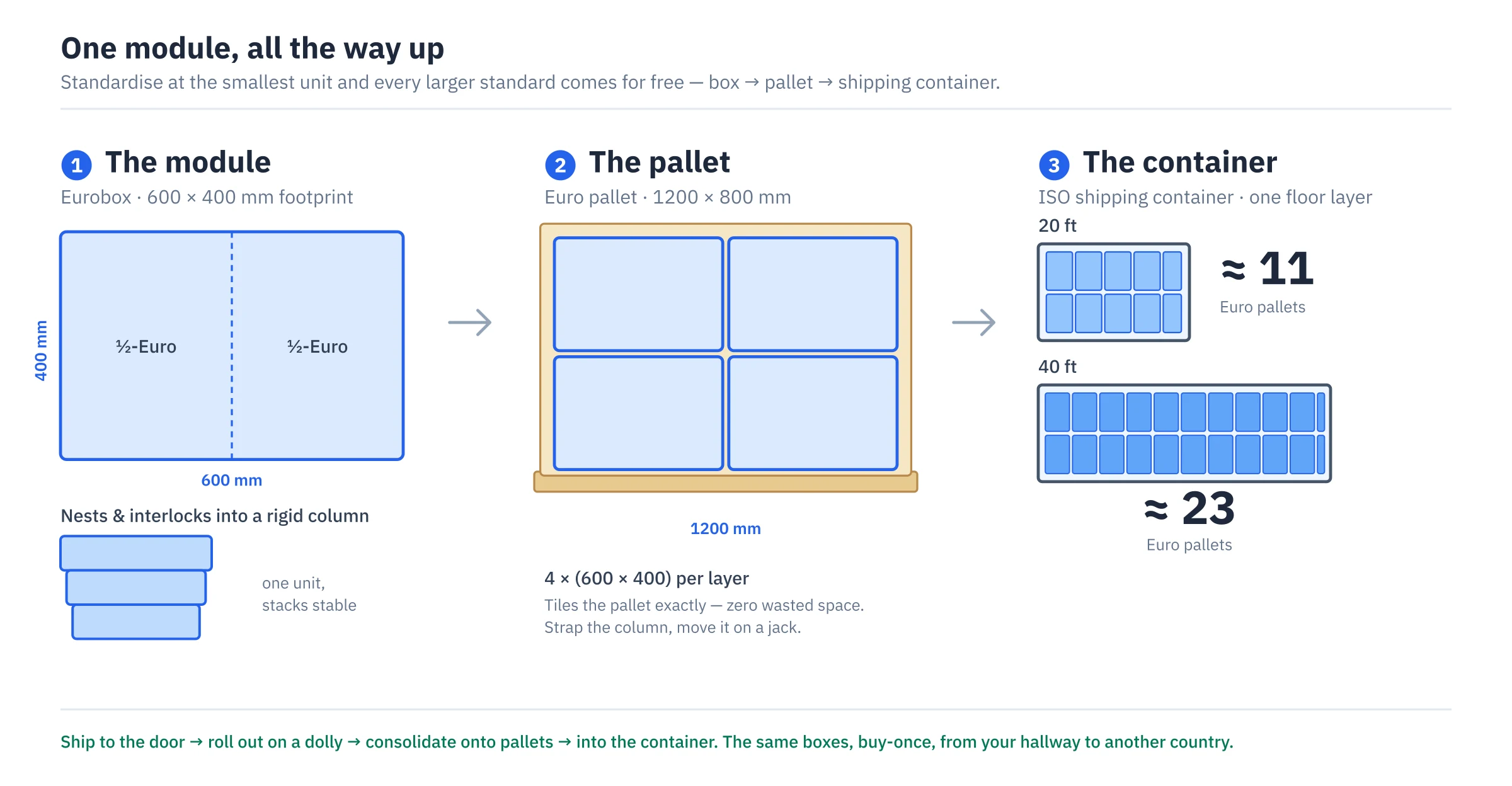
Euro containers ("Euroboxes", or KLT boxes) are built on a 600 × 400 mm footprint and its clean divisions — 400 × 300, 300 × 200, and so on.
Four of those 600 × 400 footprints tile exactly onto a Euro pallet (1200 × 800 mm), two by two, with nothing left over.
Industrial shelving is standardised to the same depths — very commonly 600 mm — so a box sits with its full footprint supported and its face flush to the aisle.
And the Euro pallet itself is sized to fill a shipping container. The same logic all the way up.
That is the whole trick. Pick your region's pallet (in Europe, 1200 × 800; in North America, 48 × 40 inches), buy boxes whose footprint divides it cleanly, buy shelving in the matching depth — and your boxes, shelves, and pallet become one interoperable system. Better still, the standard travels with you: to your next apartment, or your next country.
The tiered system: match the box to how often you touch it
The single decision that makes the whole thing work is matching the container to how often you reach for what’s inside — a tier for every access pattern, all sharing the 600×400 footprint so they still interlock:
Daily-grab — open-front picking bins (arkaliot, below) for the things you touch constantly: screwdrivers, markers, chargers.
Active storage — sealed 60×40×23 Euroboxes, the daily driver, for what you need only occasionally.
Deep storage — taller 60×40×34 boxes for bulky, rarely-touched kit: whole toolsets, seasonal gear.
Transport & archive — the same boxes, palletised and strapped, staged for moving day or long-term.
Because every tier shares the footprint, an item can move down the tiers — out of a daily bin, into a sealed box, onto a palletised stack — without ever being repacked into a different kind of container.

Being on the standard also means the accessory hardware comes for free: Eurobox dollies and platform trolleys sized exactly to the footprint, nesting lids, dividers and label holders — a whole ecosystem built around the same module.
And if you want to take the logic further, professional brands like Sortimo (the German maker behind the L-BOXX case system and van racking) build entire mounting and vehicle setups on the same idea.
Why Euroboxes beat cardboard (and consumer bins)
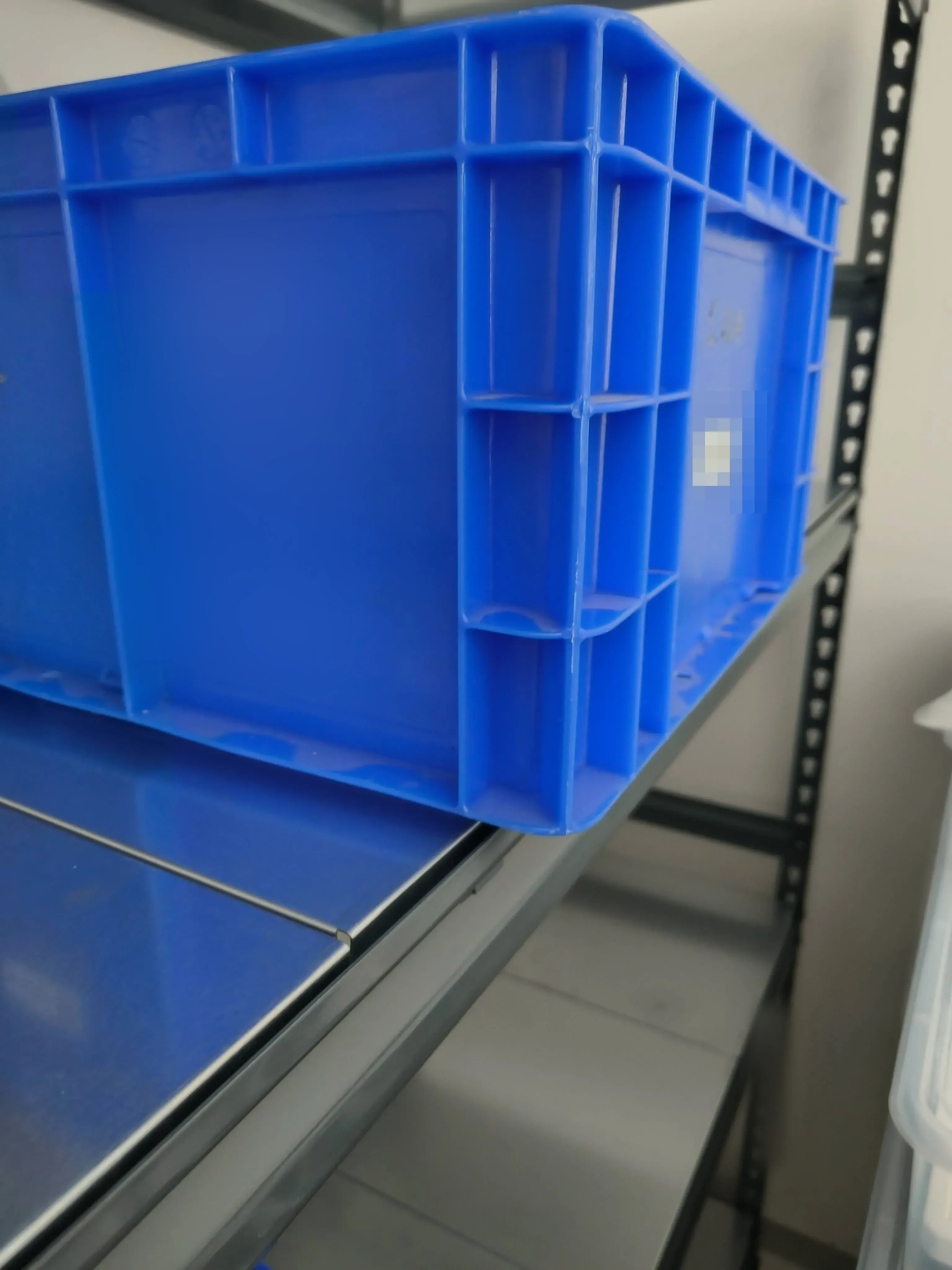
The boxes are HDPE — thick, tough, warehouse-grade plastic, not the thin polypropylene of a consumer bin. They stack by nesting onto the rim below, so a column behaves as one rigid unit; the locking lids clip on and stay on. I settled on three sizes, and bought them in the quantities our flat actually needed:
| Eurobox (cm) | Qty | What lives in it |
|---|---|---|
| 60 × 40 × 23 | ×9 | Everyday, general storage — the daily driver |
| 60 × 40 × 34 | ×3 | Deep, bulky items — whole toolsets |
| 40 × 30 × 17 | ×6 | Small parts & picking bins; the boxes that shuttle to the car |
The 40 × 30 boxes are half-Euro, so two of them sit across one 60 × 40 and everything stays on-grid.
The real gap between these and consumer storage (IKEA SAMLA and friends) is what they’ll carry. These are warehouse-rated crates, not living-room tubs.
My heaviest single box — camera rigging and accessories — I actually put on a scale at 7 kg, and it handled it without flexing or failing; a consumer tub that size would be half-destroyed.
We put our entire kitchen into a handful of Euroboxes, and they take the one thing movers quietly dread — books — without complaint. They are deceptively capable: rigid, high load rating, and genuinely satisfying to handle. That load rating is the whole reason the system holds together.
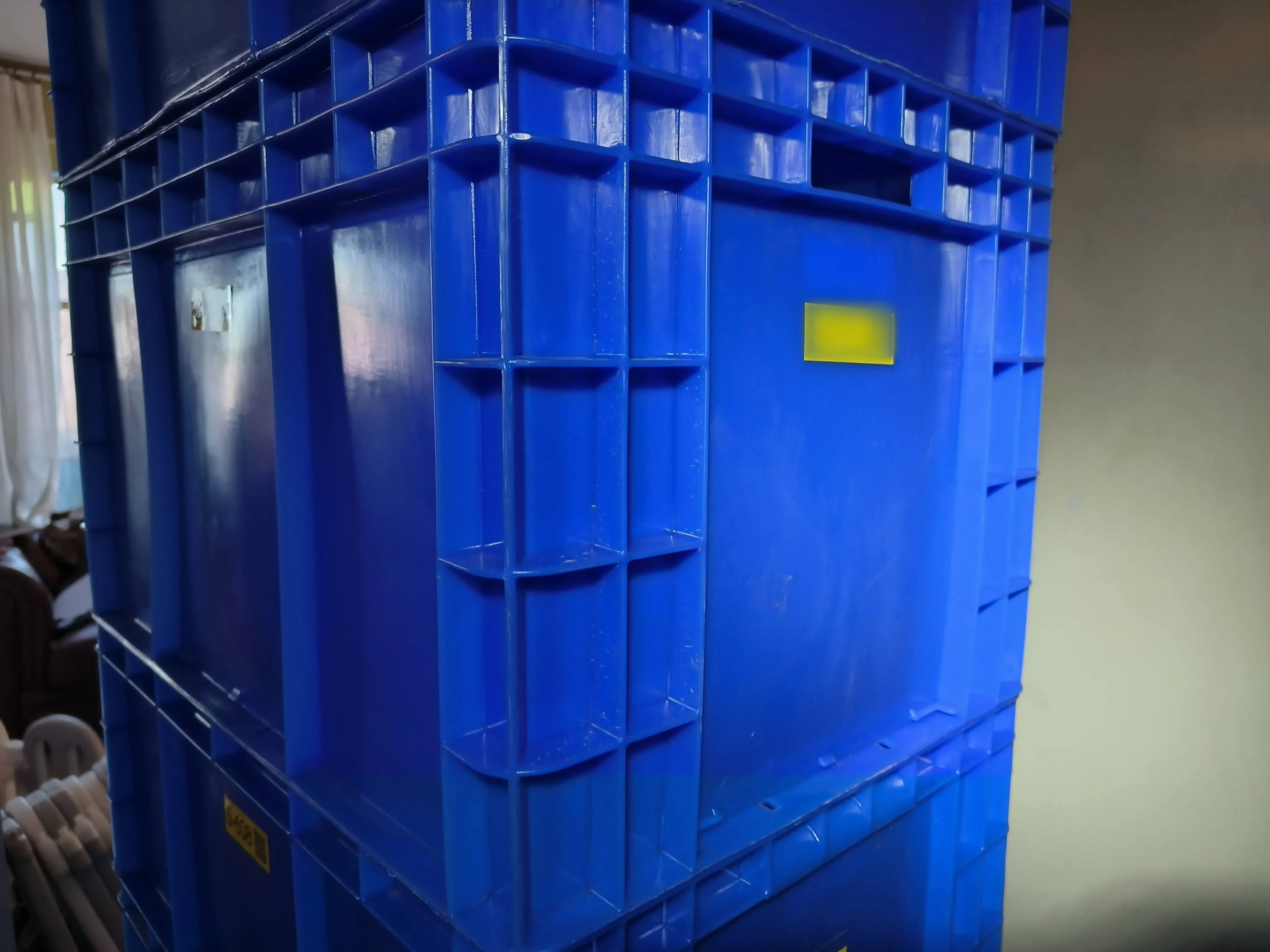
The best part is that they do double duty. Bought before a move, a Eurobox is your moving box — and then it is your permanent storage, because the box is the storage. You carry it in, set it on the shelf, and you are done. Nothing to unpack.
Cardboard is a recurring expense you throw away every time; a Eurobox is an asset that makes every future move cheaper, because the "boxes" already exist and are already packed.
The part people stop at: the price
An industrial box with a lid runs about ₪176 against roughly ₪65 for a comparable IKEA SAMLA with a clip-lock lid — about 2.7 times the price. That is the number people stop at, and it is the wrong number.
My SAMLA boxes cracked and failed after about four years; thin PP goes brittle at the rim, and Israel's sun is merciless on cheap plastic. A conservative home life for the HDPE Euroboxes is fifteen years, and realistically it is closer to buy-once.
Do the per-year arithmetic and the expensive box is the cheap one. Over twenty years the SAMLA route costs about ₪325 (you rebuy roughly every four years, sending four boxes to landfill); the Eurobox costs about ₪235, and if it simply lasts the two decades it is ₪176 against ₪325 — nearly half. Break-even lands somewhere around year eight to eleven.
None of that even counts the cardboard you stop buying every move, or the fact that these ones survive being stored outside, uncovered, in full sun — which in this climate is worth the gap on its own.

The genuinely hard part: buying the stuff
Not the stacking, not the moving — the sourcing. This ecosystem is built for B2B. Suppliers sell pallet quantities to warehouses, not mixed handfuls to households; there is no consumer webshop, minimums are quoted in pallets, and there is essentially no secondhand market (probably a testament to how long the boxes last — people keep them).
What worked was persistence: searching in trade terms ("Euro container", "KLT box", "stacking container", "picking bin"), targeting logistics and catering suppliers rather than consumer retailers, and politely asking to buy a half-pallet of one size.
A note on doing this as a private individual: it takes thrifty AliExpress purchases and a willingness to answer some awkward questions at trade counters that don’t usually sell to households. If you really want to look the part and skip the questions entirely, a clipboard and a hi-vis jacket are a remarkably effective disguise.
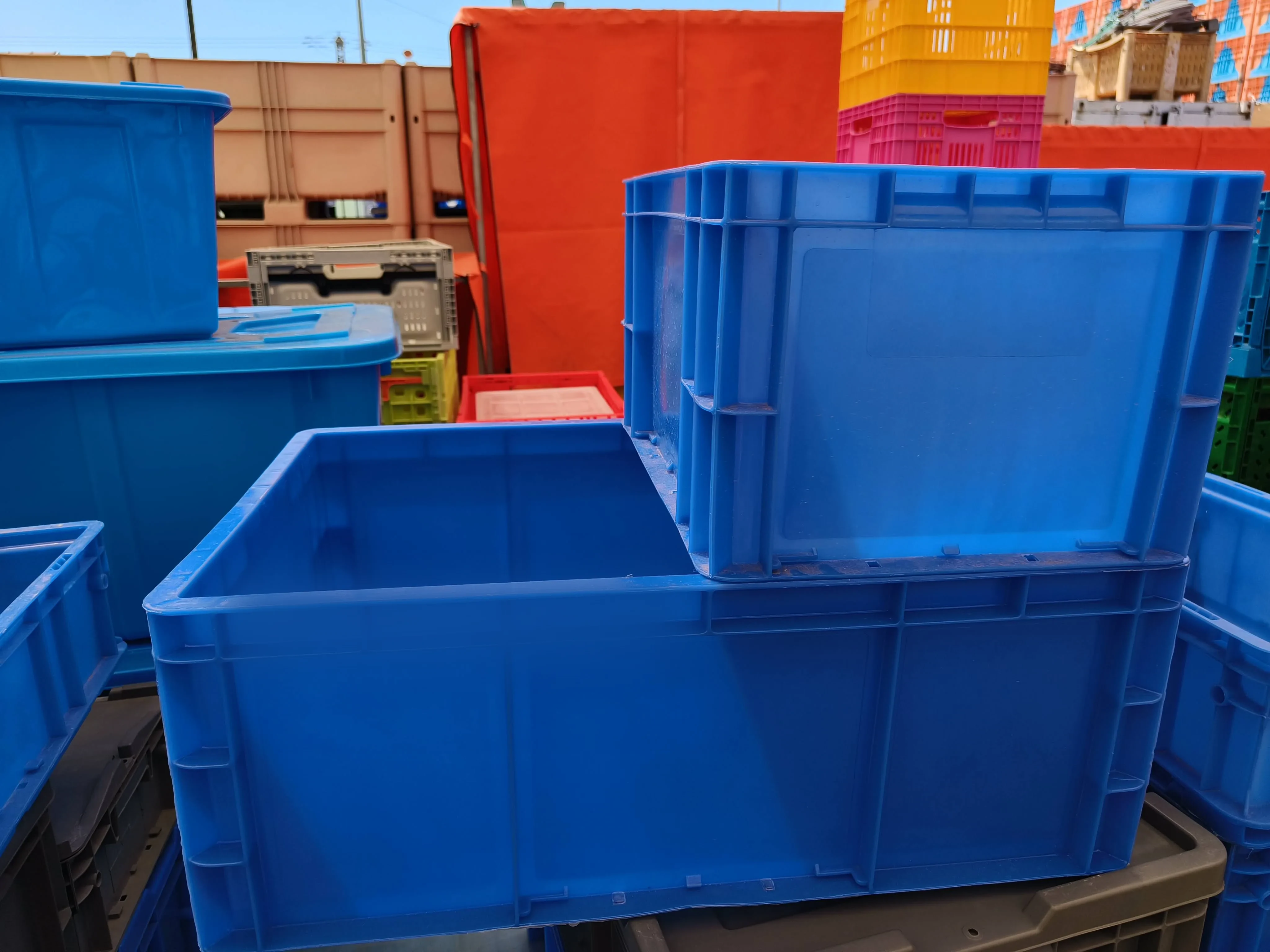
The turning point was YosiBox (there is a proper shout-out, with the shelving supplier I used, at the end).
What mattered was simple: a large B2B outfit that gave a walk-in the time of day, explained how the whole system works, and walked me through every model. A good part of the reason this project exists at all is that someone there was willing to explain a B2B system to a household buyer.
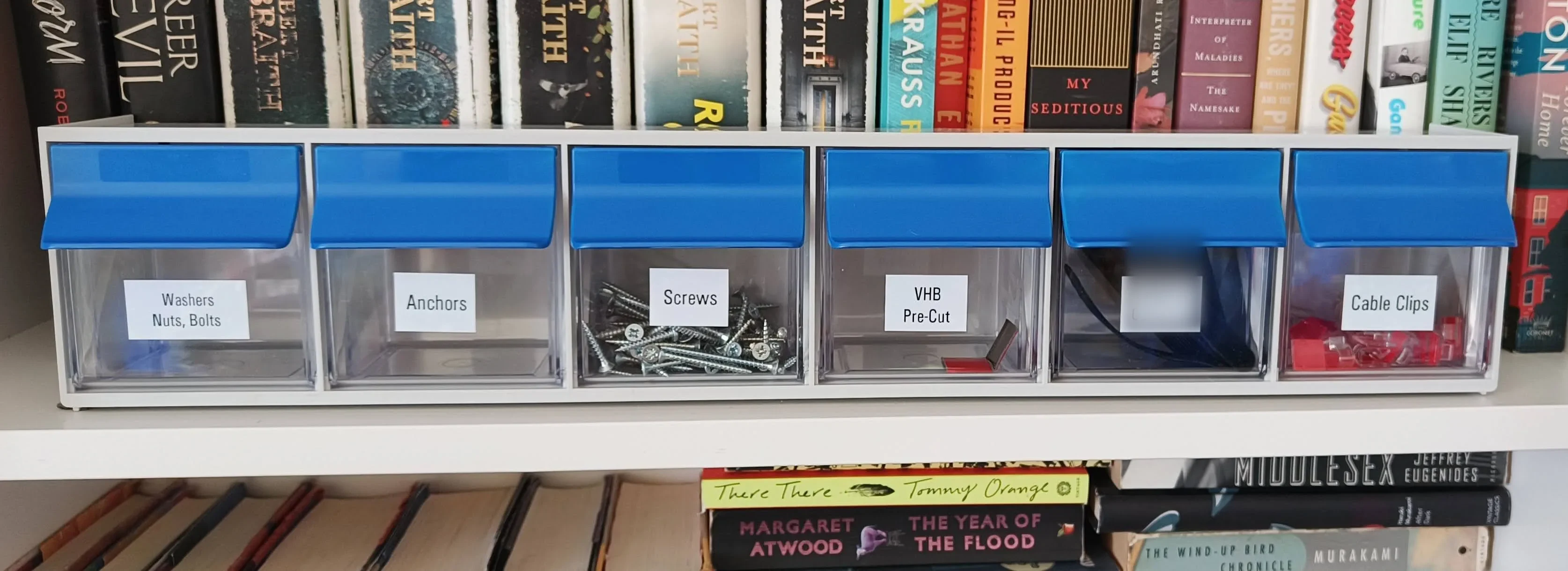
Picking bins, for the things you touch every day
Sealed boxes are miserable for daily items — you are forever lifting a lid to grab the tape. So a second container family handles fast, open access: open-front "louvre" picking bins, the warehouse pick-face standard, shaped to stack on a slope so the opening faces you.
Screwdrivers, markers, box cutters, chargers — the stuff you reach for constantly. The rule I settled on is to match the container to how often you touch the contents: sealed Euroboxes for long-term storage, open bins for the daily grab.
The Israeli standard: ארקליות (arkaliot)
In Israel the open-front picking bin has its own name and its own de-facto standard. They’re called ארקלית (arkalit, plural ארקליות / arkaliot) — a generic trade name for the open-front stackable parts bin you see on workshop shelving and in e-commerce picking.
The market is dominated by Plasgad (פלסגד), whose mould family is the de-facto national standard: bins numbered largest-to-smallest, from No. 1 at about 21 litres down to No. 5 at about a third of a litre. The full ladder, and what each size is actually good for:
| No. | External (cm) | Approx. volume | Best for |
|---|---|---|---|
| 1 | 50 × 31 × 19 | 21.4 L | The shelf-face workhorse — tape rolls, cable coils, bagged consumables |
| 2 | 35 × 21 × 20 | 8.7 L | Hand tools, chargers, power adapters |
| 3 | 24 × 15 × 13 | 3.1 L | Markers, box cutters, batteries, small hand tools |
| 4 | 17 × 10 × 8 | 0.83 L | Fasteners, connectors, cable ties, spare bits |
| 5 | 10 × 10 × 5 | 0.3 L | Screws, SD cards, tiny spares |

They’re polypropylene rather than the HDPE of the Euroboxes — UV-stabilised and colourfast, washable, and they stack about ten high free-standing.

One gotcha worth knowing before you buy: the numbering is a naming convention, not a dimensional one — Plasgad and Kingston both run 1→5 but at different sizes, so bins from different makers don’t inter-stack. Pick one maker and stay with it.
The sizes drop into standard Israeli shelving bays, and Plasgad’s larger open-front models share the 600 × 400 Euro footprint, so they pair straight into the eurobox ecosystem. Above No. 1 the range switches from size numbers to model numbers — the 180 (600 × 400 × 180 mm, ~34 L), the 220 (600 × 400 × 214 mm, ~42 L) and the 400 (705 × 441 × 300 mm, ~60 L).
Moving day, where it all pays off
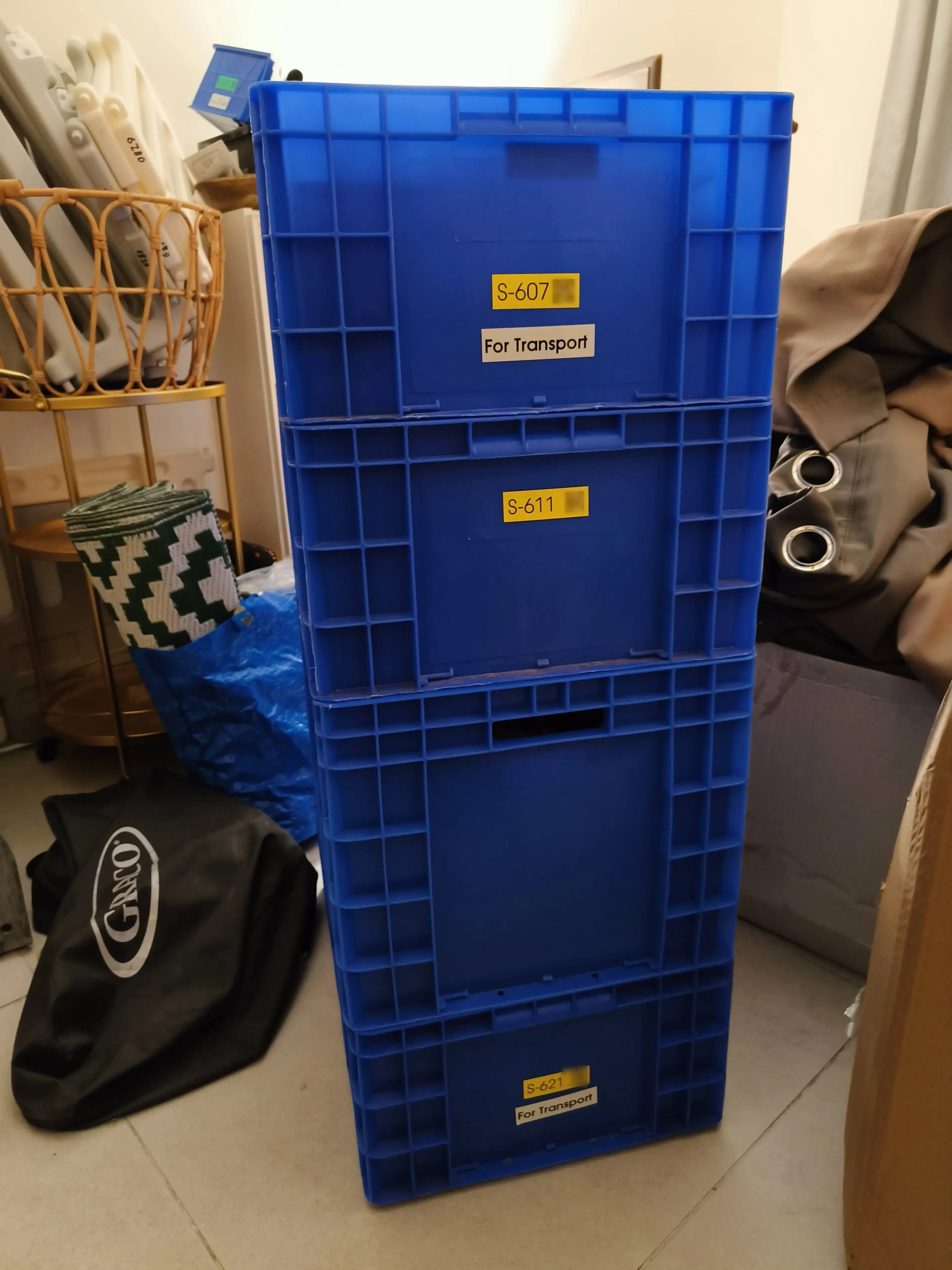
This is the argument made physical. Carrying boxes one at a time, the effort scales linearly with the box count and your body bears every kilo. Put a column of interlocked boxes on a pallet, strap it, and roll it on a jack, and the effort goes roughly flat — the wheels take the weight and you just steer.
Moving one loaded pallet is barely harder than moving two stacks side by side. Each standard hands off cleanly to the next: standardised boxes tile onto a standardised pallet, moved by a standardised jack.
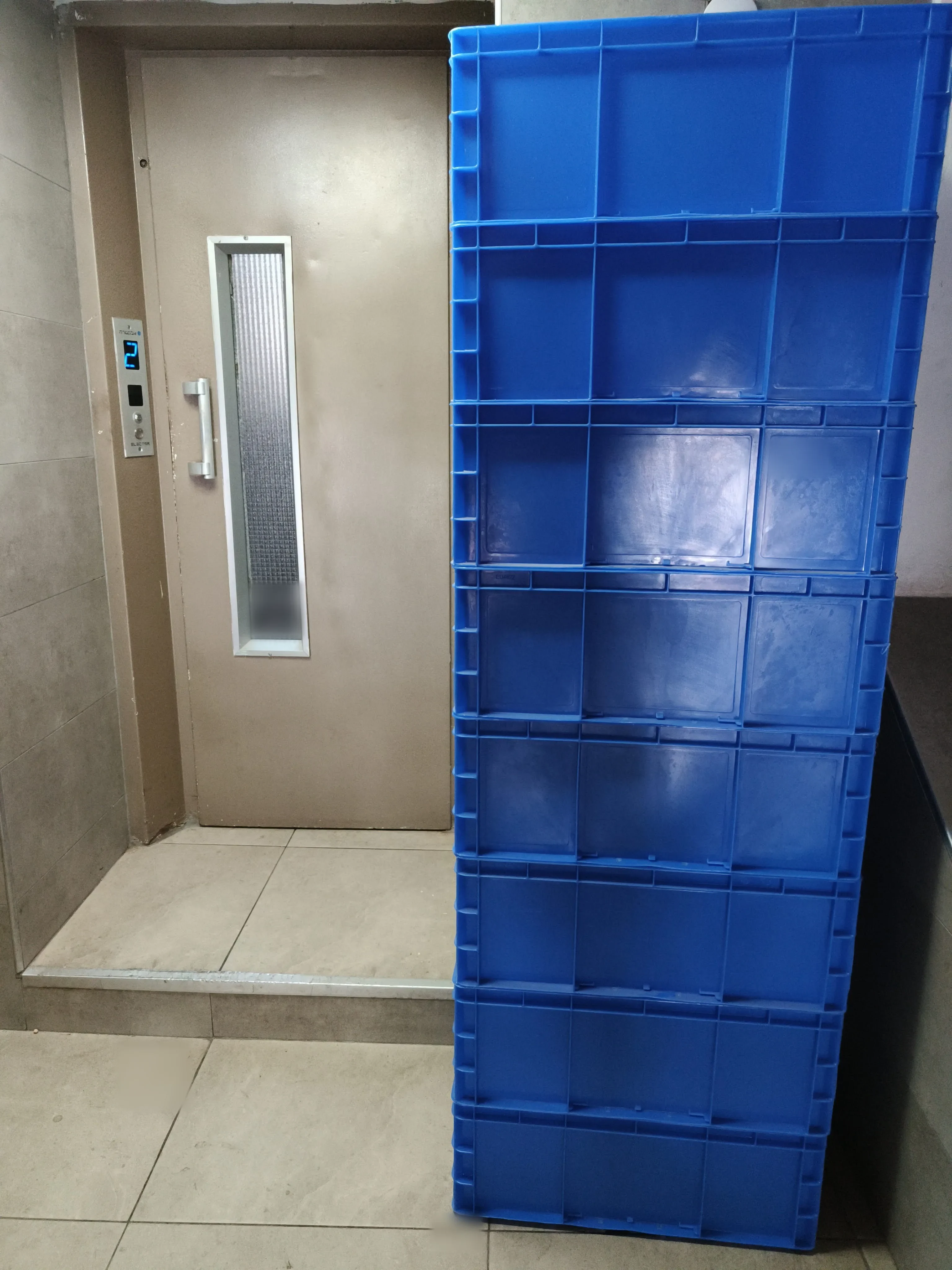
One hard-won lesson worth passing on: the elevator dominates everything. Our old building had a cab about 56 cm deep — barely room to stand — and that single fact made both the DIY and the professional parts of the move dramatically slower, because everything had to be broken down or carried down the stairs.
The new building has a proper service lift, and the same move was comfortable. When you are choosing an apartment, or booking movers, weight the elevator far more than most people do. Check the depth.
One cheap fix worth buying in advance: a threshold ramp, or even adhesive threshold tape. I added one because a platform trolley kept snagging on a terribly-planned elevator entrance — and the moment you try to roll a loaded trolley through a building, you discover just how far everyday accessibility is from where it should be.
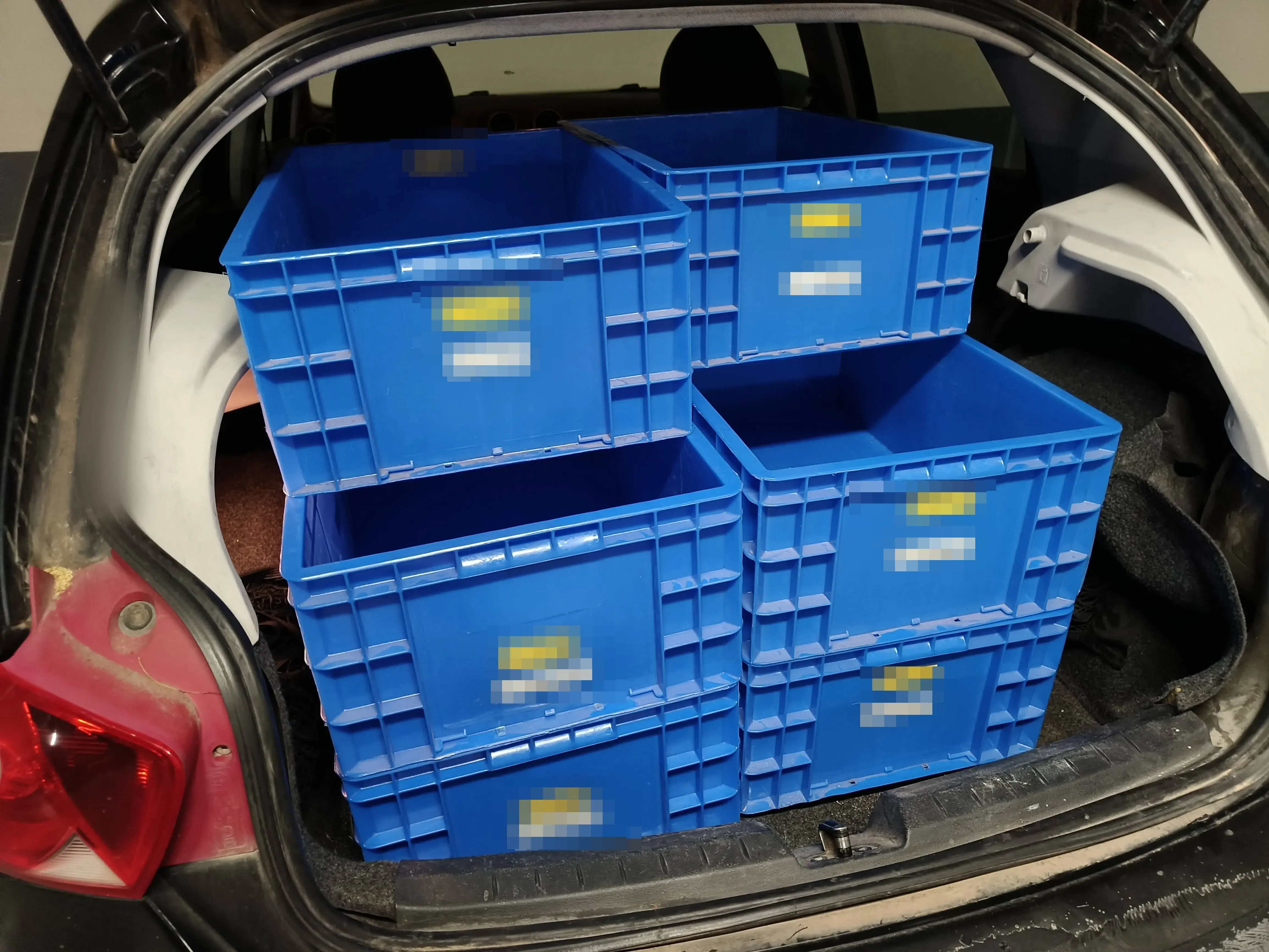
And because the boxes are rigid and uniform, they load into a car boot like they were designed for it — which, in a sense, they were.
Concretely: you can comfortably get four boxes into a normal boot, and with a bit of configuration and a strap to lock the column, up to eight — a genuinely large amount of household in one car run.
A ratchet (or cam-buckle) strap is highly recommended here; it’s the difference between a column that rides safely and one that becomes a projectile on the first roundabout.
Knowing what’s in the box: my “Where’s My Stuff” system
Standardised boxes solve stacking and moving. They do not solve finding — once everything lives in identical opaque crates, “which box is the winter gear in?” becomes the new problem.
My answer is a home-inventory system built on a self-hosted, custom fork of Homebox. Every box wears a printed barcode sticker keyed to its storage-unit ID, and its contents are logged against that ID; when I need something I search on my phone and it tells me which box — and where that box physically is. It’s fully implemented and in daily use.

The fork is closed-source for now (I may open it up later), but the part I’m proudest of is that it exposes an MCP server. So I drive the whole thing with agentic AI — printing labels and filing new items into the right box is work I hand off to Claude rather than doing by hand.
The boxes gave me a standard for storing things; the inventory system gave me a standard for knowing where they are.
Lessons learned (mostly the hard way)
A few things I would tell anyone thinking of doing this — every one of them paid for in either money or back:
Make sure you can actually receive a pallet before you order one. It sounds obvious, but a pallet arrives on a lorry and needs somewhere to be set down and broken open — a forklift or tail-lift won't ride up to your third-floor flat. Sort out ground-floor access (and a plan to get the boxes up) before the delivery, not when it's idling outside.
Check the weight rating on everything. Boxes, trolley, straps — all of it. It is the first thing for safety and the truest single signal of quality. If a spec sheet doesn't state a rating, that tells you something too.
Buy one solid convertible trolley, not two cheap ones. I bought a folding dolly and a separate platform trolley. In retrospect I'd have spent the money once on a single good steel-or-aluminium convertible — the kind that folds from a hand-truck into a platform truck — around ₪700–900. One well-made tool beats two compromises.
Check the trolley has braking casters. You would assume every platform trolley has stopping casters. Many don't. On any slope — a driveway, a loading ramp — that is the difference between a parked load and a runaway one.
For city kerbs, you need real wheels. Small hard casters are useless on Jerusalem's kerbs (or any busy urban street). To get up and over you want pneumatic tyres or larger-diameter wheels at a sensible height — and keep the pneumatic tyres properly inflated, or you lose the whole benefit.
Pack a moving-day kit. Water and something to eat (protein bars live in the car), a hi-vis vest if you're working after dark, a torch for the back of whatever you're wheeling, and reflective panels on the load. Moving is physical work at awkward hours; treat it like one.
Fit a pegboard to the end panel of a shelving unit. The side you never see becomes hanging storage for tools, cables and the things that never sit flat in a box.
At a new place, buy storage from a B2B industrial supplier from day one. Euroboxes, shelving, bins — skip IKEA for storage entirely; the consumer stuff costs more over time and won’t survive the next move.
Sizing a move in CBM (and why it scales to a shipping container)
Because every box is a known cuboid, your entire household stops being a guess and becomes a number. A 60×40×23 Eurobox is 0.055 m³ (CBM); the taller 60×40×34 is 0.082 m³; the half-Euro 40×30×17 is 0.020 m³. Add up what you own and you know your move’s volume to the litre — no more “how many boxes is a three-bedroom flat?” hand-waving.
Roughly 150 mixed Euroboxes comes to about 9–10 CBM.

That number ladders straight into freight units. A standard 20-foot container — one TEU (twenty-foot equivalent unit) — is about 33 m³ of internal volume, so a whole household on this system sits comfortably under a third of a TEU. It’s the same arithmetic a freight forwarder uses to quote a container, now available for your own move.
And because the 600×400 footprint is an international standard (VDA 4500 / EN 13199 in Europe, with equivalents elsewhere), the boxes aren’t a local hack — they’re stocked worldwide. The system is the same in a Tel Aviv stairwell and a container ship, which means it travels if you ever do.
The exit I did not plan for
Here is the part that took me by surprise. Because the boxes are the base module of a system that scales, unbroken, up to intermodal freight (see the diagram above), moving our house across a border stops being a fantasy and becomes a logistics problem with a known answer.
A shipment arrives at the door; you roll it out on a dolly; you consolidate the columns onto Euro pallets; the pallets go into a shipping container. Nothing has to be re-packed to move up a level — the box goes on the pallet, the pallet goes in the container.
And the numbers are almost comically in your favour. A 20-foot container takes roughly eleven Euro pallets across its floor; a 40-foot, about twenty-three. Your entire home, in other words, is a couple of dozen strapped columns — already staged for a lorry, a ship, or a train.
After a decade of involuntary moves, knowing the exit is mechanically simple is worth something on its own, even if I never use it.
It is also, quietly, the sustainable end of the argument. Buy the boxes once and the same units carry every move — a flat across town or a container across the sea — for fifteen or twenty years, instead of a fresh pile of cardboard each time. Fewer things made, fewer things thrown away, and the whole chain from box to container is built to be reused.
Was it worth it?
Completely — though I would be lying if I said the appeal was purely financial. There is a real pleasure in a system that fits together on purpose, and in knowing that the next move (because there will be a next move) starts with our lives already boxed, labelled, and ready to roll.
I cannot change Israel's rental law from my hallway. But I have made each move cheaper, faster, and less punishing than the last, and that turned out to be the part actually within my control.
The way I think about the cost now: the boxes are a CapEx — a real, lumpy upfront spend — but they collapse the OpEx of every future move (all the cardboard, tape and replacements you never buy again). Seen over a decade of moves it’s the cheap option, not the expensive one.
It is an expensive system to stand up, and I’ll say it plainly: I wish I’d known about it ten years ago — I’d have done it then.

I wrote the whole thing up as a field manual — every box size, the cost workings, the sourcing notes, the standards tables — at github.com/danielrosehill/warehouse-apartment. It is CC-licensed; take whatever is useful.
GitHub Repository danielrosehill/warehouse-apartment Field manual for a home storage & moving system built on industrial logistics standards (Euroboxes, pallets, picking bins) — born of Israel's tenancy-at-will rental market. ★ 4PythonUpdated Jul 2026 View on GitHubThe shopping list
If you want to copy the setup, here is roughly what to buy, grouped by job. Tap a heading to expand it.
Boxes & bins
Euroboxes with locking lids: 60 × 40 × 23 (general), 60 × 40 × 34 (bulky), 40 × 30 × 17 half-Euro (small parts).
Open-front "louvre" picking bins for daily-access items.
A few lidless half-Euro totes for the shuttle-to-the-car runs.
Moving equipment
One good convertible hand-truck / platform trolley — with braking casters and pneumatic tyres.
Ratchet or cam-buckle straps to lock a column to the trolley or pallet.
A furniture dolly (four-wheel) for the heaviest single items.
Euro pallets and, if you can borrow one, a pallet jack for the actual move-out.
A rubber mallet — boltless (rivet) industrial shelving assembles by tapping the joints together; no bolts, no drill.
A threshold ramp / adhesive threshold tape — keeps a loaded platform trolley from snagging on door sills and lift entrances.
Consumables & labelling
Inventory labels (I use QR codes) and a permanent marker.
A decent box cutter and a roll of wrap or paper for fragile gaps.
Edding oil / permanent markers — invaluable for marking boxes; find them at industrial or building-supply stores. Sakura is a good alternative.
A Brother P-touch Cube + TZe tapes — 24 mm for box identifiers, 12 mm for individual items. Source the tapes (e.g. TZe-231) from AliExpress in packs of 10 for the best pricing.
Safety & night kit
Work gloves and a hi-vis vest for after-dark loading.
A torch, and reflective panels for the load.
Water and snacks — moving is physical work at awkward hours.
Suppliers
The two Israeli suppliers that made this system possible. If you want into it, start here.

YosiBox — יוסיבוקס
By their own description Israel's largest and longest-running storage-solutions supplier: over forty years of Euro containers, pallets, platforms, picking bins, dollies and carts — for sale and rental, with nationwide delivery.
This is where the boxes, the pallets and the moving gear came from, and the walk-in guidance that got me started. Web: yosibox.com · Phone: 03-9153158.
Where: near Ashdod. Open YosiBox in Google Maps.

Kingston Technologies — קינגסטון מדפים
Industrial and home shelving and storage units — the racking side of the system. Shelving sized to the same depths as the boxes is what turns a pile of Euroboxes into a proper storage wall, with the full footprint supported and the faces flush to the aisle. Web: madafim.co.il.

Where: the Har Tuv industrial estate, near Beit Shemesh. Open Kingston in Google Maps.
A short Hebrew glossary
For anyone shopping for this gear in Israel, the words that actually get you the right product:
ארגז / ארגזים (argaz / argazim) — crate / box; a storage Eurobox is an ארגז אחסון.
ארקלית / ארקליות (arkalit / arkaliot) — open-front stackable picking bin.
מדף / מדפים (madaf / madafim) — shelf / shelving.
משטח (mishtach) — pallet.
פלסגד (Plasgad) — the Israeli plastics maker whose bins are the de-facto standard.
יוסיבוקס (YosiBox) — the storage-solutions supplier near Ashdod.
קינגסטון מדפים (Kingston Madafim) — “Kingston Shelving,” the racking supplier in Har Tuv.
דמי תיווך (dmei tivuch) — broker / agent fee.
חוק השכירות והשאילה — the Rental and Lending Law; its 2017 amendment is the Fair Rental Law.
Tools and downloads from this project
Two things came out of working all this out. Both are free to use:
Eurobox logistics calculator — enter quantities by box size and it works out the total volume, how many Euro pallets that becomes at a given stack height, and how much of a 20 ft container you would fill. It draws the pallet layer layout and prints to an A4 report.
3D models of the boxes and shelving — true-scale GLB models of the Euro containers, the attached-lid container, the picking bins and the shelving bay, released under CC BY 4.0. Spin them in the browser, download them one at a time or as a set, or load a size straight into the calculator from its 3D models section.
Standards & further reading
The Eurobox / KLT standard (EN 13199) — the 600 × 400 mm footprint family the whole system is built on.
The Euro pallet (EPAL / EUR, 1200 × 800 mm) — the master unit the boxes are sized to divide.
ISO shipping containers (ISO 668) — the top of the chain: 20 ft and 40 ft, ship, rail and truck.
Israel's Fair Rental Law, 2017 — background on the tenancy rules that started all this.
