
Promise Denied: charting Iran's escalating strike campaign with open-source data
Published: 24 - Mar - 2026
Since April 2024, Iran has launched four rounds of direct military strikes against Israel — operations it designates "True Promise" (عملیات وعده صادق). Promise Denied is an open-source intelligence project I've been building to track, analyse, and visualise this campaign — wave by wave, missile by missile.
The dataset now covers 72+ attack waves across all four operations, with granular records on weapon types (Shahed drones, Emad and Ghadr ballistic missiles, Fattah hypersonics, cruise missiles), target locations, interception systems engaged, and escalation indicators. All data is published on GitHub, Kaggle, and Hugging Face.
Below are some of the charts and analyses generated from the dataset. All charts were produced using AI-assisted analysis (Claude Opus) of the underlying OSINT data and should be treated as informational — always verify against primary sources.
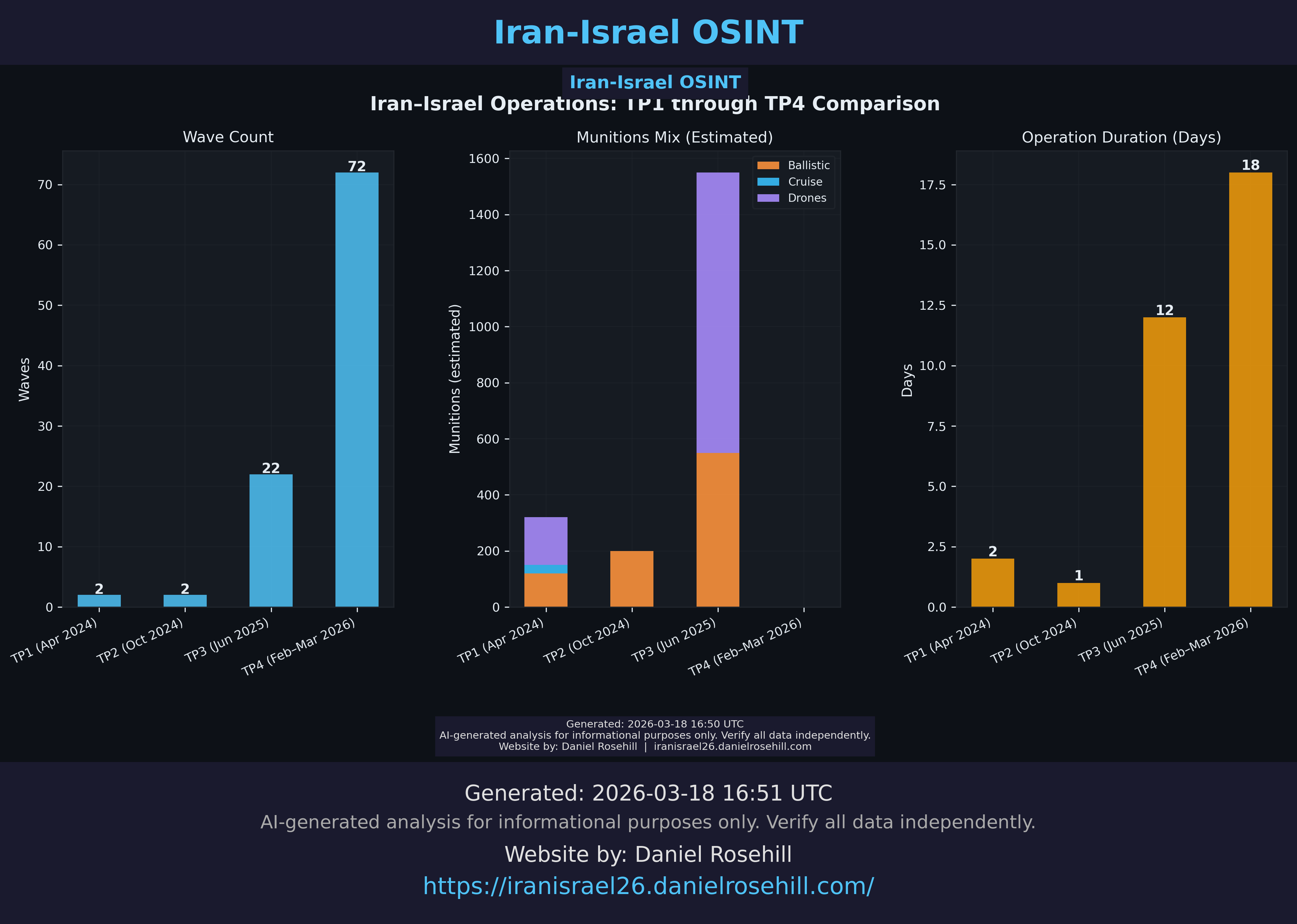
Four operations, escalating scale
The cross-operation comparison tells the story at a glance. True Promise 1 (April 2024) was a single night with ~320 munitions. By True Promise 4 (February–March 2026), the campaign had expanded to 72 waves over 18+ days, with strikes reaching US and coalition bases across 12 countries.

Operational tempo: TP3 vs TP4
The cumulative timeline chart overlays TP3 (June 2025) and TP4 (February–March 2026), showing how wave frequency evolved over the hours since each operation began. TP4 maintained a more sustained tempo over a longer period, though TP3 had more intense initial bursts.

Weapon system evolution
The weapon deployment chart maps which systems appeared in each wave. TP3 relied heavily on Ghadr and Emad ballistic missiles with Shahed-136 and Shahed-131 drones. TP4 shows a shift toward more diversified payloads including cruise missiles and MARV-equipped warheads — a notable capability upgrade.

TP4 munition composition
Across TP4's 29 waves, ballistic missiles dominated at 87% (either alone or combined with drones and cruise missiles). Pure drone-only waves were relatively rare, suggesting Iran prioritised speed-of-arrival and penetration capability over the slower Shahed swarms seen in earlier operations.

Target geography
The targeting comparison shows how Iran's geographic focus shifted between TP3 and TP4. TP3 concentrated heavily on the Tel Aviv metro and northern periphery. TP4 spread strikes more broadly — notably introducing US base targeting as a major new dimension, with strikes hitting installations across the Middle East, Indian Ocean, and Pacific.

Escalation indicators
This multi-panel view tracks four key escalation markers across TP4: the number of countries targeted per wave, cluster munition use, US base targeting, and hypersonic missile deployment. The data shows a pattern of progressive escalation — cluster munitions appeared from wave 19 onward, and hypersonic-capable Fattah missiles were used in at least 6 waves.

About the project
Promise Denied is an open-source OSINT project. The interactive map, full dataset, and additional analysis are available at promisedenied.com. The dataset is maintained using AI-assisted research (multi-model LLM queries combined with manual verification) and published under open data licenses.
The project includes an interactive operations map showing launch sites and target locations, a weapon systems reference with photos and specifications, and exportable data in JSON, CSV, GeoJSON, and Neo4j graph database formats.
Data quality disclaimer: This dataset was assembled using AI-assisted research, news reporting, and publicly available OSINT sources. It may contain inaccuracies or gaps. Timestamps are approximate for many events. Always cross-reference against primary sources.
Daniel Rosehill
AI developer and technologist specializing in AI systems, workflow orchestration, and automation. Specific interests include agentic AI, workflows, MCP, STT and ASR, and multimodal AI.
