
The dazzling physics of the Iranian ballistic missile threat
Published: 24 - Mar - 2026
One of the things that's hardest to convey about the Iranian ballistic missile threat is the sheer physics of it. The numbers are so extreme that they almost defy intuition. These are not small projectiles. They are enormous, extraordinarily fast, and carry devastating payloads.
The following visualizations are drawn from Promise Denied, an OSINT project I maintain that documents the Iranian threat to Israel. The physics page attempts to make these numbers tangible.
The arsenal
Iran operates a diverse arsenal of ballistic missiles ranging from short-range systems like the Shahab-1 to medium-range and hypersonic weapons like the Fattah series. The full inventory includes MRBMs, SRBMs, and maneuverable reentry vehicles (MARVs).

How tall are these missiles?
The smallest Iranian drones (Shahed-131 and 136) stand at roughly human height. But the ballistic missiles dwarf everything around them. The Sejjil, Iran’s most advanced solid-fuel ballistic missile, stands 18 meters tall — nearly twice the height of a three-storey building. The Emad, Ghadr, and Khorramshahr-4 are each 16 meters. Even the "smaller" Kheibar Shekan is 11.4 meters.

How heavy are they?
To make these numbers relatable, the project benchmarks launch weights against an African elephant (roughly 6,000 kg). The Sejjil weighs 23,600 kg at launch — nearly four elephants. The Emad and Ghadr each weigh 17,000 kg, almost three elephants apiece. Even the Fattah-1 weighs 4,300 kg.

Explosive payloads
The warhead weight — the explosive payload, not the total launch weight — ranges from 15 kg on the small Shahed-131 drone up to a staggering 1,000 kg on the Khorramshahr-4. The Emad and Ghadr carry 750 kg warheads each, and the Sejjil carries 700 kg. These are enormous conventional payloads.

Speed: beyond comprehension
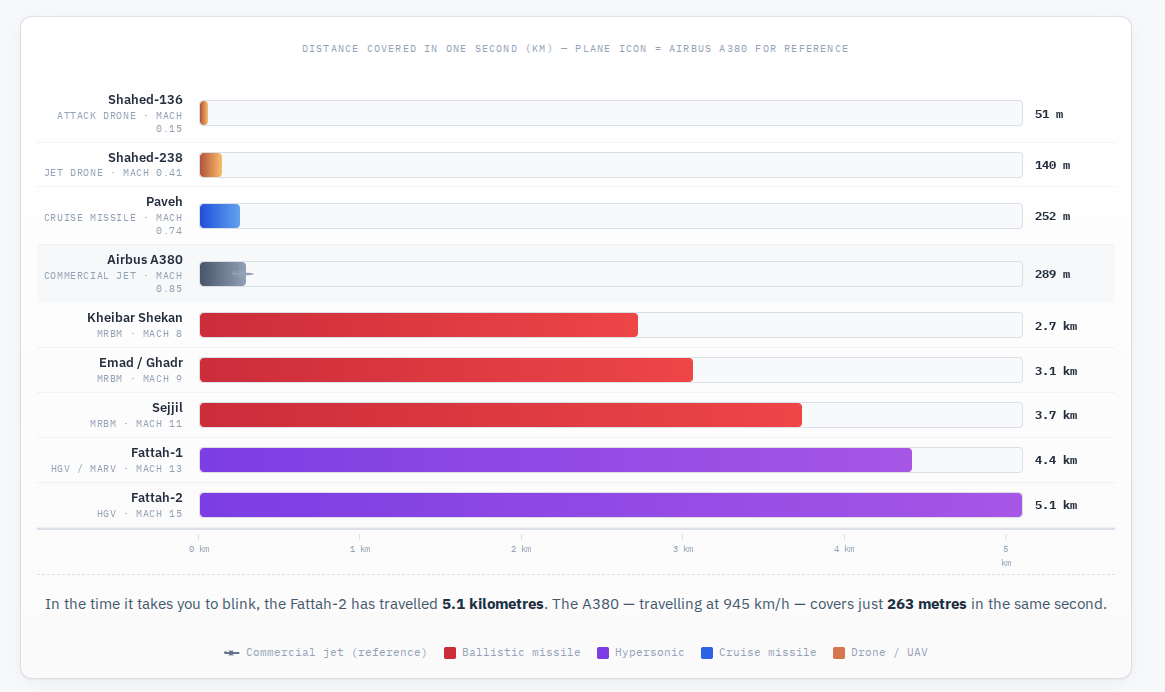
This is where the physics become truly staggering. Iran’s liquid-fuel ballistic missiles (Emad, Ghadr, Kheibar Shekan, Khorramshahr-4) travel at approximately Mach 9 — nine times the speed of sound. The solid-fuel Sejjil reaches Mach 11. And the Fattah-1 hypersonic missile achieves Mach 13 to 15.

For comparison, an Airbus A380 cruises at Mach 0.89. The Fattah-1 travels roughly 15 times faster than a commercial airliner.

What does one second of flight look like?
The Promise Denied project includes a race visualization that shows how far each weapon system travels in a single second. In the time it takes you to blink, the Fattah-2 has covered 5.18 kilometers. The Fattah-1 covers 4.42 km. Even the "slower" liquid-fuel missiles cover nearly 3 km per second. The interactive version on the site slows one second down to 10 real seconds so you can actually watch it unfold.

Minutes to Tel Aviv
From western Iran (Kermanshah region, roughly 1,000 km away), a Fattah-1 reaches Tel Aviv in approximately 4 minutes. A Sejjil takes about 5 minutes. Liquid-fuel MRBMs like the Emad, Ghadr, and Kheibar Shekan arrive in 5 to 6 minutes. From central Iran (Isfahan, roughly 1,500 km away), the times stretch to about 6 to 8 minutes. That is the entire decision window.

Cluster warhead capability
Several Iranian missile systems are assessed to have cluster warhead capability — the ability to deploy multiple submunitions from a single missile. This dramatically increases the area of effect and complicates interception.

A proven and present danger
These are not theoretical weapons. Iran launched ballistic missiles at Israel on April 13, 2024 and again on October 1, 2024. The scale and speed of these weapons is difficult to internalize without visualization. A single Khorramshahr-4 carries a metric ton of explosives and arrives at hypersonic speeds. Iran can launch dozens simultaneously.
For the full interactive experience — including animated comparisons and the one-second race — visit the physics page on Promise Denied.
All graphics sourced from promisedenied.com/threats/physics.
Daniel Rosehill
AI developer and technologist specializing in AI systems, workflow orchestration, and automation. Specific interests include agentic AI, workflows, MCP, STT and ASR, and multimodal AI.
